The sheet price on a box of tile is not the number on a San Diego backsplash quote. Labor, layout, waste, grout, trim, and outlet cutouts live on other lines, and those lines follow the wall in your kitchen. A verifiable installed average for kitchen backsplash cost San Diego could not be confirmed from City or County data, so the useful move is an itemized bid that splits tile, labor, demo, and electrical.
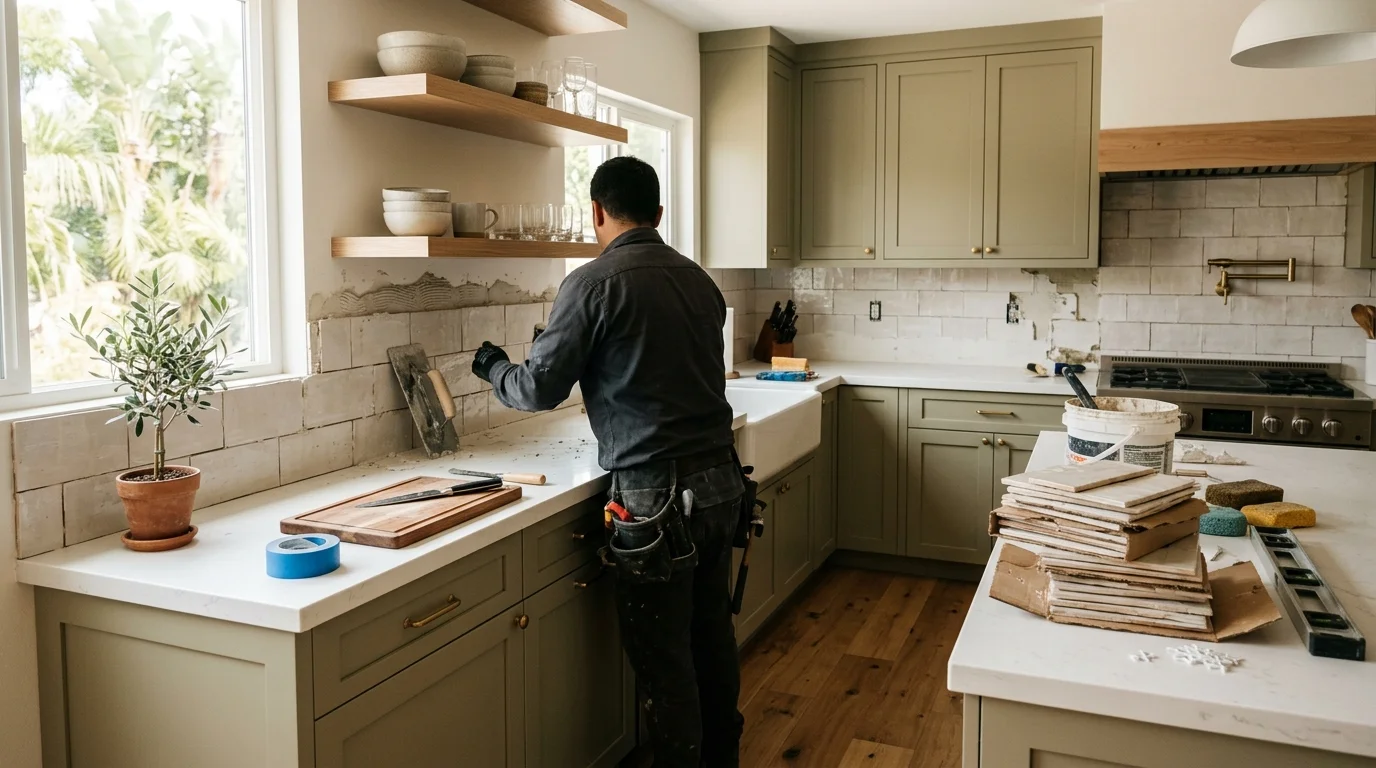
Tile price versus the installed number
A tile price is a material line. The installed number is the whole job.
Ceramic subway, handmade-look zellige, and porcelain all show up on San Diego backsplashes, and they do not set the same way. A machine-made subway tile field is usually faster to lay than a wavy handmade sheet that wants a looser joint. Porcelain in a large format can mean fewer grout lines and more careful cuts around outlets and windows. Those differences live in hours on the wall, not in the box.
We match you with licensed, independent kitchen remodelers. They set the price. Modern Kitchen SD does not sell tile, keep a yard, or publish a per-square-foot rate.
Ask for the material line and the set line as separate numbers. If a bid blends them, you cannot tell whether you are paying for clay or for time in a Clairemont galley. If you are still choosing a look, start with kitchen backsplash tile and the current tile trends guide rather than shopping from a single advertised square-foot figure.
San Diego County is not one kitchen type. A short splash in a 1990s Mira Mesa tract home is a different wall than a full-height field in a North Park bungalow with plaster that is out of square. Coastal kitchens in Ocean Beach, Pacific Beach, and Imperial Beach take salt air and more indoor-outdoor cooking mess. Inland kitchens in El Cajon, Santee, and Escondido take more heat and sun on west-facing walls. Encinitas and El Cajon do not share housing stock, cabinet heights, or wall flatness, so a quote that could be copied from one city to the other is not a real quote.
National chain install add-ons were not independently confirmed for this page. If a retailer quotes backsplash installation cost, put that sheet next to a local itemized bid and compare scope. The same is true of any “average cost to replace a kitchen backsplash” you see online. No City of San Diego, County of San Diego, or CSLB dataset publishes that figure.
Labor, layout and the waste factor
Kitchen backsplash labor is where most of the quote moves.
A straight running-bond field on a flat run is the simplest layout. Herringbone, vertical stack, mosaic sheets, and a decorative band all add cuts. Every outlet, window return, and inside corner adds more. The installer who prices the wall should walk it with a tape, not guess from a listing photo.
Waste is real. Tile breaks, edges get cut, and dye lots should match. This page does not publish a standard overage percentage, because no official San Diego source sets one. Ask the pro to write the extra quantity they are ordering and why. A small kitchen in a downtown or Mission Valley condo can waste a high share of a box because the run is short and the cuts are many. A long, simple run in Rancho Bernardo or Carmel Valley can use more tile and still waste less as a share.
Layout also includes what is already on the wall. Painted drywall, wallpaper, existing ceramic, and old mastic each change demo and prep. In Hillcrest, North Park, and older South Bay houses, crews often find more than one finish stacked on the same plane. The bid should say who patches, who supplies backer if the substrate is wrong, and who hauls the debris.
A San Diego labor-per-square-foot average could not be confirmed from an official source. Access still changes the day: street parking in University Heights, stairs in a Golden Hill duplex, elevator reservations under a condo HOA. Those are job conditions, not a published rate table.
If the splash is part of a larger remodel, say so in the scope. Tile set after new counters and cabinets is a different sequence than tile set in a kitchen you are still cooking in. Sequence belongs on the quote, next to the labor line.
Full height versus a short splash
Height is a cost lever because it is area, pattern, and trim at once.
A short splash that stops a few inches above the counter uses less tile and fewer cuts into the uppers. A field that runs from the counter to the bottom of the cabinets covers the grease zone people actually wipe. A full-height panel behind the range, or a wall that keeps going where there are no uppers, is a different job again.
Open shelves, a window over the sink, and a pass-through toward a patio all change the edge count. Coastal north county kitchens in Encinitas, Solana Beach, and Carlsbad often borrow light from a garden window. East County and South Bay galley kitchens more often have a solid run and a tighter aisle. Same county, different cuts.
Stone or quartz remnants used as a slab splash are priced by the fabricator, not by the tile setter. Do not mix those quotes without labeling which trade owns the wall. If you want the splash to sit inside a larger kitchen design plan, lock height and material before anyone orders boxes. Height changes also change outlet extensions, under-cabinet light clearance, and whether the hood still sits proud of the field.
People ask whether a backsplash raises home value. Remodel recoup percentages are widely repeated and could not be verified from a City or County of San Diego source, so this page does not publish one. What you can verify is the wall you will live with: wipeable, finished at the edges, and consistent with the rest of the kitchen.
People also ask if $30,000 is enough for a kitchen remodel. That is a whole-kitchen question. Cabinets, counters, appliances, and layout dwarf a tile field. A verifiable average remodel cost for San Diego could not be confirmed from official data. Use a tile backsplash cost quote as one line in a larger budget, not as a stand-in for the room. For the wider budget conversation, read the kitchen remodel cost in San Diego guide and treat every figure there the same way: if it is not sourced, it is not a number to bank on.
Grout, trim and electrical cutouts
Grout is a finish and a labor line.
Sanded, unsanded, and epoxy grouts are not interchangeable, and they do not take the same time to joint and clean. Color that matches the tile hides joints. Contrast shows every wavy line, which matters on handmade-look fields. Ask the quote to name the grout product, the joint width, and who seals if the product needs it. Do not accept “grout included” with no product.
Trim is the edge you will see from the dining room. Metal edge, tile bullnose, pencil liner, and a simple caulk joint against the uppers each take different material and different minutes. Inside corners and the cooktop side splash are where cheap trim looks unfinished.
Electrical cutouts are where a neat field goes slow. Every receptacle and switch needs a box extension if the tile is thick, a clean cut, and a plate that sits flush. Do not assume the tile setter is also the electrician. If outlets move, or if you want new under-cabinet lighting, that is a separate electrical scope. Current California Electrical Code details for kitchen receptacles could not be verified from a primary source for this ledger, so do not let a blog post tell you what the circuit must be. Have the licensed electrician on the job speak to the wall in front of them.
Building permits may be required depending on the scope of work. A tile-only field on an existing wall is not the same as a job that opens walls or adds circuits. The City of San Diego does not publish kitchen-specific permit dollar triggers online. Confirm the trigger for your address with San Diego Development Services. Addresses outside the city go through the county or the city that actually issues the permit. For how permits show up on a larger kitchen, see kitchen remodel permits in San Diego.
How to read a backsplash quote from a local pro
A useful quote is boring on purpose.
It should split tile (including tax and extra quantity), setting labor, demo and haul-away if anything comes off the wall, substrate repair or backer if needed, grout, trim, and caulk, electrical cutouts or an electrician allowance, protection of counters and floors, and what happens if the wall behind the old tile is shot.
If those lines are missing, you are comparing vibes. Two San Diego bids that look far apart often hide different heights, different patterns, or one installer assuming you already bought the tile.
Ask whether the number is a fixed price for a written scope or an allowance that moves when the SKU changes. Allowances are fine when you have not picked a tile. They are a problem when you think you locked a number.
California home improvement contracts have rules that are not optional. California Business and Professions Code §7159 caps a down payment at $1,000 or 10 percent of the contract price, whichever is less, and that limit must appear in the contract in at least 12-point boldface type. On a $8,000 contract, 10 percent is $800, so $800 is the cap. On a $15,000 contract, 10 percent is $1,500, so $1,000 is the cap. Buyers who did not negotiate at the contractor’s place of business may cancel within three business days of receiving a signed contract. Senior citizen buyers receive five business days under the same statute. Confirm the current text before you sign.
Verify the license yourself on the CSLB License Check before you put a deposit down. License status is legal status, not a quality guarantee. Kitchen work that needs a permit, exceeds the minor-work exemption, or is advertised as contracting is not casual handyman territory under California B&P Code §7048. That exemption applies only when the aggregate contract price for labor, materials, and all other items is less than $1,000, the work is casual and minor, and no building permit is required. Dividing a job to stay under that figure does not create an exemption.
The installer we connect you with sets the price. Walk the same walls with two or three pros, keep the scope identical, and only then decide.
When to call us
When the splash is more than a peel-and-stick strip, or it wraps a window, a cooktop, or a wall of outlets, you want a licensed kitchen remodeler to price the field. Call us at (858) 400-4623 and we’ll connect you with a licensed local kitchen remodeler.