A cabinet quote for a San Diego kitchen often hinges on the box, not the paint. Face-frame construction still sits in most 1960s and 1970s tract kitchens from Mira Mesa to El Cajon and Clairemont. Frameless, full-access boxes are the usual ask in newer coastal condos, from La Jolla south through downtown.
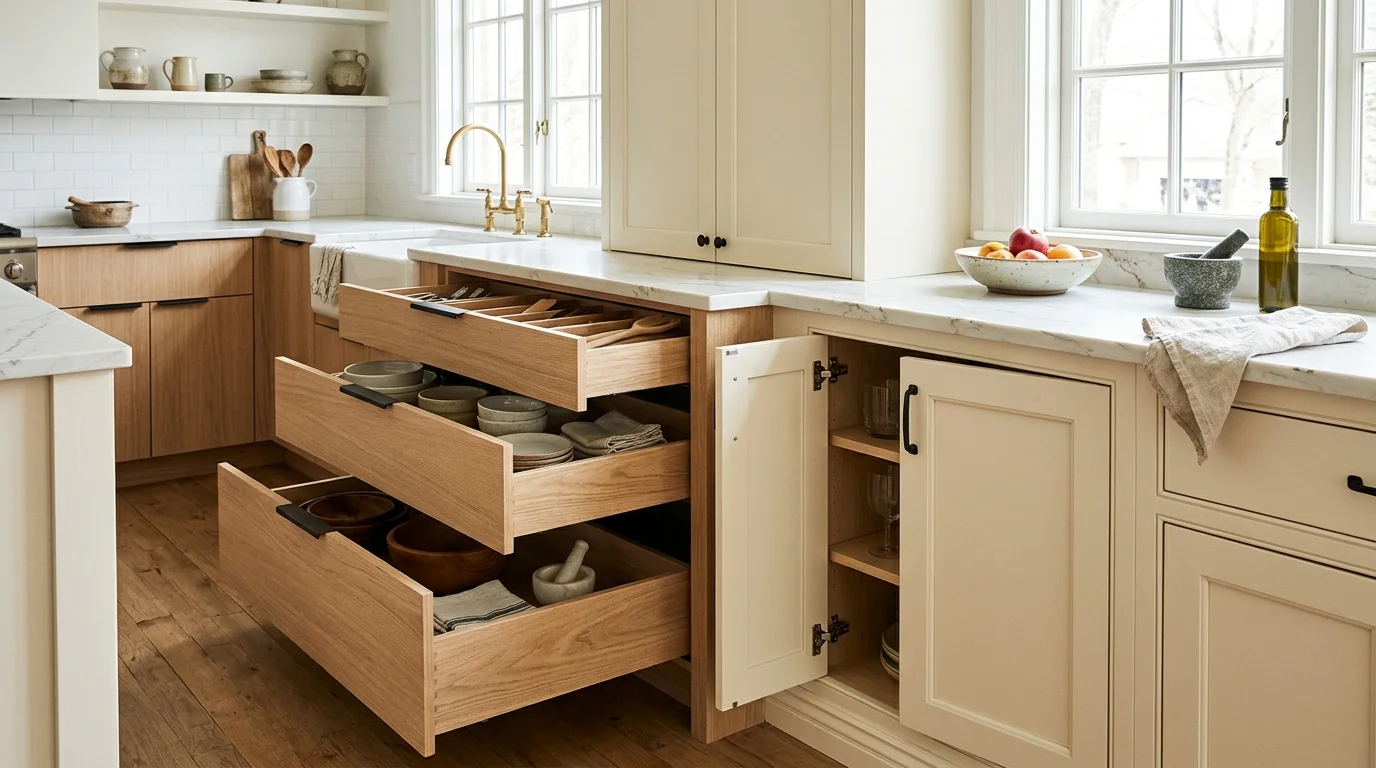
What each box style actually is
A face-frame cabinet is a box with a wood frame on the front. The vertical pieces are stiles. The horizontal pieces are rails. Doors and drawers hang on that frame, not on the thin edge of the box. The frame is the picture-frame look around each opening. If you open a base cabinet in a Clairemont ranch and see a wood lip around the hole, that is a face frame.
Frameless kitchen cabinets skip that front frame. Doors and drawers hang on the box itself. The front you see is the door plus a thin edge of the box. Shops also call these full-access cabinets, or European-style cabinets. That name describes the construction, not where the factory sits. A San Diego shop can build either. A quote that lists full access cabinets vs face frame is naming this same split.
This is not the same decision as custom versus stock cabinets. Stock, semi-custom, and custom are buying channels. Face-frame and frameless are how the box is built. You can buy a stock face-frame line. You can also order custom kitchen cabinets as frameless boxes. If you are still choosing a buying channel, read the semi-custom cabinets guide first. Come back here when the quote lists framed or frameless as its own line.
Neither style is automatically the stronger box. A well-joined frameless box with a solid back can stay square for decades. A cheap face-frame box can twist if the installer skips shims. Ask to see box thickness, back-panel attachment, joinery, and hardware. Those details matter more than the brochure name.
The people who specify and hang the boxes are licensed, independent remodelers. Modern Kitchen SD matches you with those pros. We do not build cabinets, hang doors, or pull permits. Before you sign, check the contractor’s license on the CSLB site.
Drawer space and the filler strip problem
The frame eats the opening. On a face-frame cabinet, the stile and rail sit inside the clear opening. A drawer has to shrink to clear that lip. A wide platter or a stockpot has to tilt to get past it. Over a full run of bases, that lost width adds up, especially in a galley.
Frameless boxes skip that lip. The drawer can run closer to the full width of the cabinet. The opening is the box, not the box minus a frame. That is why quotes call them full-access. In a small Pacific Beach or downtown condo kitchen, that extra drawer width is the whole argument.
The tradeoff is fillers. Frameless doors and drawers are nearly as wide as the box. They need clearance to swing past a wall, a fridge, or the next door. Designers drop filler strips at those edges so the fronts do not bind. Face frame cabinets can often scribe or overlay with less filler because the frame itself is the buffer.
Walk a coastal condo plan and you will see fillers at the walls and beside the range. Walk an East County ranch with a long wall of bases and fillers hide easier. Ask the designer to mark every filler on the elevation. A filler is not a defect. It is how frameless doors get room to open.
Do not treat a catalog storage claim as a quote. Opening width depends on the line, the hinge, and the drawer hardware. Compare two sample boxes of the same cabinet width, side by side, with the drawers open. That is the only measurement that belongs on your job.
Doors, overlay and the look from the room
Overlay is how much door sits on top of the cabinet front when everything is closed. Face-frame lines usually offer three looks. Inset doors sit inside the frame, flush with the stiles. Partial overlay (sometimes called standard overlay) leaves a band of frame showing around each door. Full overlay covers most of the frame and leaves a thin reveal.
Inset is the most traditional look, and the least forgiving. Wood moves with humidity. San Diego is milder than the Midwest, but a Mission Hills or North Park house still sees seasonal change. Inset doors that bind in August are a known headache. Partial overlay is more forgiving. Full overlay on a face-frame box can read almost as clean as frameless, if the reveal is tight and even.
Frameless cabinets are almost always full overlay. There is no frame to inset into. The doors cover the box. The gaps between doors are the design. That tight, even grid is the look in a lot of newer Encinitas and Little Italy kitchens. It also means the installer has almost no room to hide a wall that is out of plumb.
Door style is separate from box style. You can put a shaker door on a frameless box. You can put a slab door on a face-frame box. The box decides overlay options and interior access. The door decides the style from across the room. If you want inset, you need a face frame. If you want the doors to cover the whole front, either construction can get you there, with different reveals.
From the room, face-frame still reads as the American tract-home kitchen: Clairemont, Mira Mesa, Santee, parts of Chula Vista. Frameless reads as the newer coastal condo and the gut remodel that wants one plane of doors. Neither is the most popular style in a way you can trust from a blog. In this county the split follows the housing stock.
Cost and lead time differences you should ask about
No honest per-foot price belongs here. Box construction is one line on a quote, mixed with species, finish, hardware, and how many boxes are modified. A frameless run is not automatically more expensive. A face-frame inset kitchen can cost more because the fit has to be exact. Compare itemized quotes from independent local shops. Ask them to show box construction, hinge type, drawer slides, and fillers as separate lines.
Ask what the shop is actually building. Some lines are face-frame with full-overlay doors that look frameless until you open a drawer. Some frameless lines use thinner sides and need more fasteners into the wall. Have the remodeler put a sample of each on the floor of your kitchen, not only in a showroom with level floors.
Lead time is a shop question, not a brand promise. Modern Kitchen SD does not publish mill times or install windows. Ask each shop how long their framed line and their frameless line currently take, and whether modifications add a second wait. Get that in writing on the quote. If two shops quote different constructions, you are not comparing the same job.
If the existing boxes are sound and you only want new doors and skin, kitchen cabinet refacing keeps the boxes you have. In a 1970s face-frame kitchen, that means you stay on face-frame construction. You are not switching to full-access drawers unless the boxes come out.
Building permits may be required depending on the scope of work. Cabinet-only swaps are not the same job as moving walls or plumbing. For City of San Diego projects, Development Services is the office that can tell you what your specific scope needs. Do not guess from a blog.
Which style fits a 1970s box versus a new layout
A 1970s box in Mira Mesa, El Cajon, or Clairemont was almost certainly face-frame. The walls are often out of square. Floors slope. Soffits drop over the uppers. Face-frame cabinets give the installer a frame to screw through and a little room to shim. That forgiveness is a real benefit in those houses.
Frameless cabinets need the run to be plumb, level, and true. A small twist in an old wall shows up as a door that binds. That is the main downside of frameless cabinets in East County and inland North County tract homes. The box itself is not fragile. The install is less forgiving. If you want frameless in a 1970s kitchen, budget for wall correction, scribes, and a careful layout, not only for pretty doors.
A new layout is a different job. If the walls come down, the soffits come out, and the floor gets leveled, frameless becomes easier to hang well. That is why you see it in gut remodels and in newer coastal condos that were framed closer to square. Storage is tighter in those condos, so full-access drawers earn their keep.
If you are keeping the old boxes, you are keeping face-frame. Refacing, new doors, and paint do not change the opening width. If you want wider drawers, the boxes have to come out. That is a custom kitchen cabinets conversation, not a hardware swap.
Neither frame nor frameless is better as a rule. Face-frame wins when the house is older, the look is traditional, or you want inset doors. Frameless wins when you need every inch of drawer, you want a tight grid of full-overlay doors, and the walls can be made true. Pick from how you cook and what the house will allow, then have two licensed local shops price the same layout both ways.
When to call us
Call when you are choosing box construction for a remodel, not when you only need a hinge tightened. A licensed kitchen remodeler should measure walls, mark fillers, and quote framed and frameless as real options on your plan. Call us at (858) 400-4623 and we’ll connect you with a licensed local kitchen remodeler.