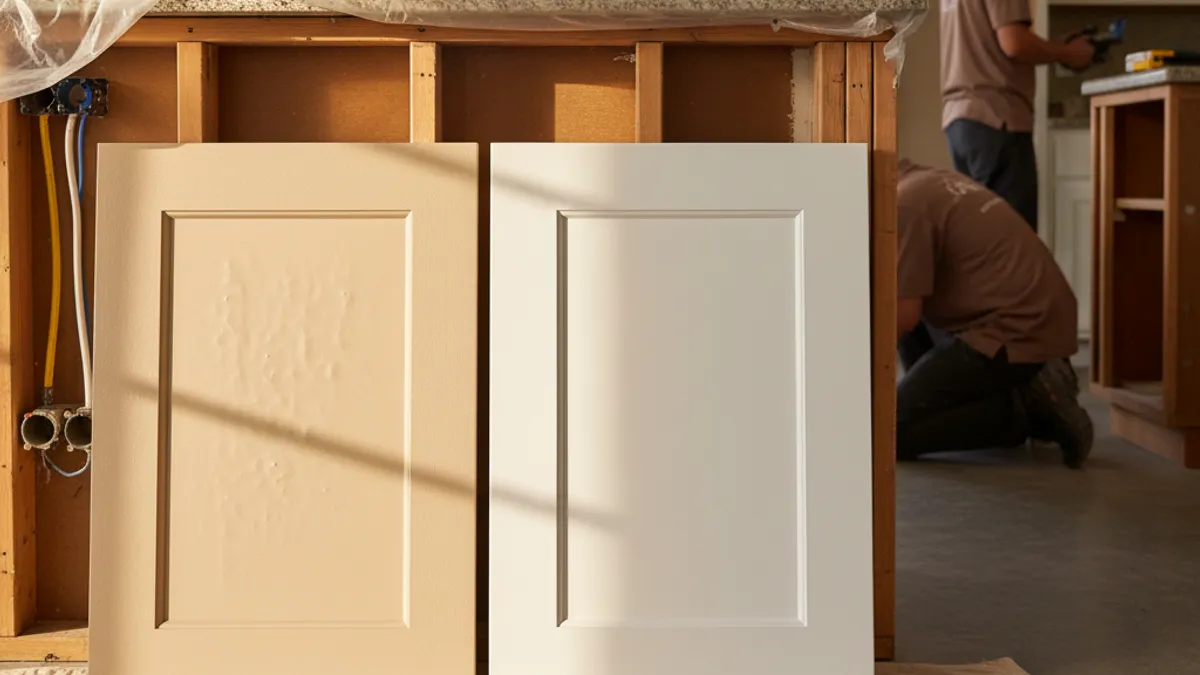
Stock, semi-custom, and custom are sales labels. They are not a price, a lead time, or a promise that the boxes will fit your kitchen. The useful comparison is how the cabinets are specified: a fixed catalog, a dealer line with a published option list, or a shop that builds from field measurements. Read that source, then see whether it solves the room.
This page does not publish San Diego cabinet price bands, lead times, or a share of remodel cost. Those figures are not in the approved research. It also does not treat KraftMaid as a stock example. KraftMaid is a dealer catalog line with its own install rules.
Three ways cabinets actually get specified
Start with who owns the drawing, the order, and the install. A home-center box, a dealer showroom, an online catalog, and a local shop can all sell “cabinets” and mean four different packages. Our guide to buying kitchen cabinets in San Diego walks through those sources. This page is the construction comparison.
A stock catalog sells finished sizes from a published list. The kitchen plan has to fit those sizes. Fillers and panels close the leftover gaps. IKEA SEKTION is a named catalog example. A published SEKTION wall cabinet (US product 00265463) hangs on a SEKTION suspension rail sold separately, the fasteners are not in the box and must match the wall, and that cabinet’s published depth is 14 3/8 inches without the rail and 14 3/4 inches with it. IKEA also prints a falling-hazard warning. Those figures are for that product sheet. They are not a universal stock-cabinet size. The point is the method: a catalog system, not a shop-built box.
A dealer line is made to that manufacturer’s catalog, then sold through a kitchen seller. Options, modifications, and construction details are whatever that line currently publishes. KraftMaid, Merillat Classic, and Aristokraft each have their own install guides. Do not paste one brand’s rules onto another, and do not call the group “stock” because a showroom also sells stock.
A shop-built custom job starts with the room. A local shop measures, draws, builds, finishes, and usually installs. That can solve angles, soffits, and built-ins a catalog cannot. It is still not unlimited. Shops have construction methods, finish systems, and hardware they actually build. “No fillers” and “any size” are claims to verify on the drawings, not features of the word custom.
If you already know the room needs fitted work, the custom kitchen cabinets service is the matching path. If the boxes are staying, compare this page with cabinet refacing instead of forcing a new order.
KraftMaid is not a stock box
KraftMaid shows up in San Diego dealer quotes. Treat it as the line on the proposal, not as a synonym for big-box stock.
The current KraftMaid installation, care, and cleaning guide (Cabinetworks Widen file 2406, retrieved 2026-08-16) says the cabinets are not freestanding. They must be attached to a wall stud or anchored to the floor, or the warranty is void. Typical wall-framing studs are described as 16 inches on center. KraftMaid install screws may be used in metal studs. Wall cabinets 36 inches and 42 inches wide need extra screws through the center hanging rail. Island or peninsula bases that are not on a wall stud must be secured to the floor. The line is designed for indoor use.
Those are KraftMaid rules. They are not Merillat rules. Merillat Classic’s framed install guide warns that nails or drywall screws void the product warranty and specifies #10 x 2-1/2 inch hang-rail-to-wall screws. Aristokraft’s January 2024 spec sheet says wallboard alone is not strong enough to support the cabinets. Wellborn’s install guide uses #8 x 2-1/2 inch screws, forbids drywall screws, and publishes humidity limits for its cabinets. If two quotes name two brands, read both sheets.
Ask the dealer which KraftMaid collection is on the bid, which sizes and modifications that collection allows, and which of those modifications are actually on your elevation. A modification that exists in a brochure is not on your order until it has a product code.
Plan the room, then pick a tier
The kitchen decides the tier more than the budget slogan does.
If the room is a simple rectangle with a standard ceiling, a catalog or dealer line may fit with documented fillers. If the kitchen has an angle, a soffit, a vault, a beam, an off-center window, or a column, a stock grid will fight the architecture. That is the moment to price a shop drawing against a dealer modification list, not the moment to hope fillers will disappear.
Do not use years-in-the-house as a rule. Staying fifteen years does not require custom cabinets. Selling in five years does not require stock. Ask what you need the cabinets to do: storage, finish, appliance fit, and whether the layout will change. A homeowner remodeling a 1990s Mira Mesa L-shape may be well served by a dealer line that fits the grid. A 1970s Clairemont ranch with an angled wall and a soffit may need a shop. A coastal La Jolla kitchen with a vault and a beam is a drawing problem before it is a brand problem. A Kensington or North Park craftsman with original built-ins is a matching problem.
Fillers are not automatically a failure. They are a failure when their width and location are a surprise. Ask for a dimensioned elevation that marks every box, finished end, appliance opening, and filler. Our semi custom cabinets guide is the middle-path checklist for catalog modifications.
Lead time is whatever the named manufacturer and installer currently quote for that order. We could not confirm a San Diego stock, dealer, or custom range, so this page will not publish one. Split the schedule into measure, approval, production, delivery, and install, and write what can move each date.
How to read the quote
A clean cabinet quote is a product list plus an install list. If it is one lump called “kitchen cabinets,” ask for a breakdown.
The cabinet line should show manufacturer or shop, door style, finish code, box construction, and a count or linear plan. Exposed ends, panels, toe kicks, crown, and fillers should appear as pieces, not as atmosphere. Hardware should name hinge and runner brands, or at least the series. Install should say who measures, who receives the delivery, who reports damage, and who scribes to the wall.
Compare construction from samples and spec sheets, not from the words plywood or custom. Open the display box. Ask which displayed parts match your written order.
For covered California home improvement contracts, Business and Professions Code §7159 limits the down payment to $1,000 or 10 percent of the contract price, whichever is less. Verify the contractor through the CSLB License Check. License status is legal standing, not a cabinet warranty.
Building permits may be required depending on the rest of the remodel. Cabinet supply by itself is not a City of San Diego trigger we can publish. Confirm the wider scope with Development Services at 619-446-5000, or with the authority for your address. If cabinets are only one slice of a gut kitchen, price them inside the full kitchen remodel sequence so counters, plumbing, and flooring are not guessing at box locations.
When to call us
Call when you need a licensed remodeler to measure the kitchen, put stock, dealer, and shop-built options on the same drawing, and show what each catalog cannot do. Modern Kitchen SD matches San Diego County homeowners with licensed, independent local professionals. Call us at (858) 400-4623 and we’ll connect you with a licensed local kitchen remodeler.