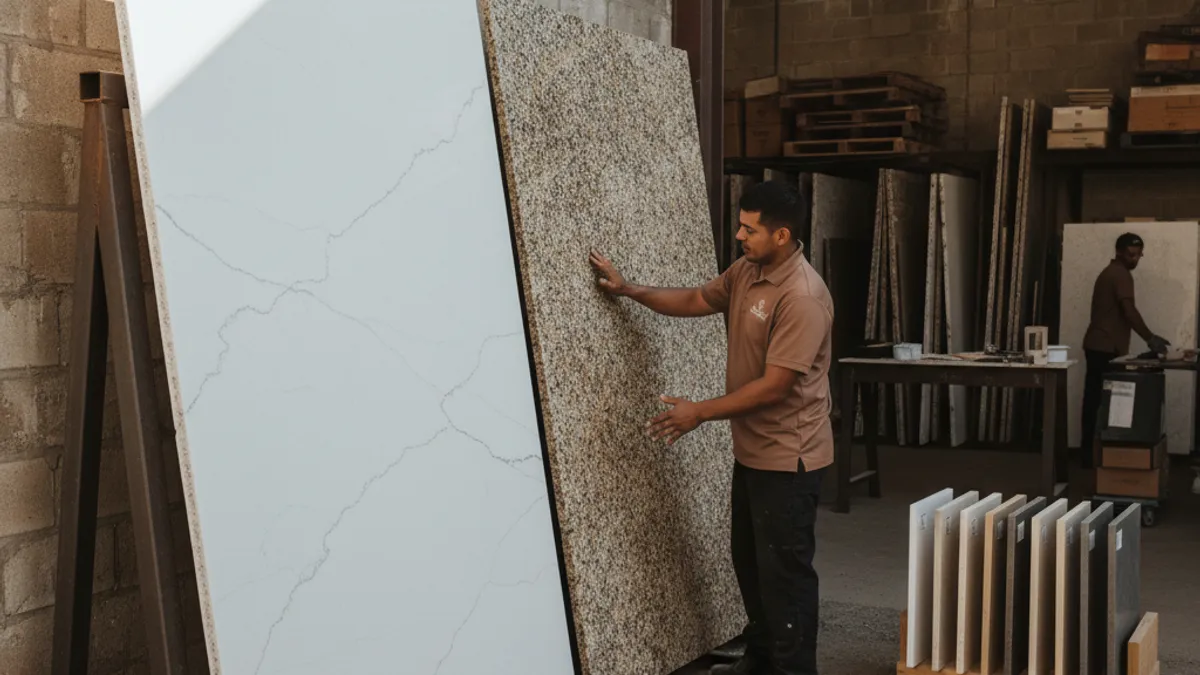
Granite and quartzite are both natural stone. They are not the same rock, and a yard label is not a lab report. USGS lithologic classification treats granite as a plutonic igneous rock and quartzite as a metamorphic rock formed by recrystallization of sandstone or chert. The Utah Geological Survey says the same in plainer words: granite cooled from magma; quartzite is typically metamorphosed sandstone with interlocked quartz grains.
If you’re also weighing an engineered surface, use our quartz vs quartzite and quartz vs granite pages. This one stays with the two quarry stones.
What granite is
Granite is an intrusive igneous rock. Slow cooling underground is why you see distinct mineral grains. Those grains are commonly quartz, feldspar, and mica, though the mix changes by quarry. That is geology, not a color guarantee. You still pick the actual slab.
The Natural Stone Institute groups stones as calcareous or siliceous. Siliceous stone is made mostly of silicates such as quartz, feldspar, and mica, and is generally more resistant to common kitchen acids than calcareous stone. NSI still says acidic cleaners are not the daily plan, because a siliceous slab can include acid-sensitive minerals.
Porosity is slab-specific. NSI’s sealing position says most granite countertops do not strictly need sealer, that many still get an impregnating sealer as extra stain resistance, and that sealer does not make stone stain-proof. Ask the supplier whether this slab was resin-treated at the factory and which sealer, if any, they want used after install.
What quartzite is
Quartzite, in the USGS sense, is a granoblastic metamorphic rock made mainly of quartz. Heat and pressure recrystallize sandstone so the grains interlock. That is why fabricators talk about hardness and why a marble-look quartzite is still not marble, if the identification is honest.
NSI’s care chart places quartzite with siliceous metamorphic stone. True siliceous quartzite is generally more acid-resistant than calcareous marble. That is a mineral class, not a license to skip care. NSI says hydrofluoric acid attacks silicates. Toilet-bowl cleaners and some rust removers can contain it. Keep those off granite and quartzite.
Porosity still varies. Some quartzite is tight. Some takes liquid faster. NSI says sealing is a repellent, not a waterproofing layer, and that the supplier should set whether this stone needs an impregnator and how often to check it. Don’t copy a “reseal every year” rule from a different slab.
Don’t identify a slab with lemon juice
Some yards sell a marble-look stone as quartzite. A calcareous impostor will etch. That labeling problem is real. A home acid test is still a bad way to settle it.
Lemon juice, vinegar, and wine are the same acids NSI says can dull or etch calcareous stone. Putting them on a slab you might buy can leave a dull spot on the very surface you’re trying to protect. It also doesn’t give you a written mineral identification you can keep with the contract.
Ask for documentation instead:
- The quarry or supplier name and the commercial slab name.
- Whether the seller is calling it granite, quartzite, marble, or dolomitic marble, in writing.
- The current care and sealing sheet for that stone, not a generic “natural stone” flyer.
- Whether a fabricator, petrographer, or supplier will confirm the geological class before you sign.
If the seller will not put the stone type on the invoice, treat the label as marketing. Walk.
Care, heat, and sealing without kitchen myths
NSI’s daily method is the same starting point for both stones: blot spills, don’t wipe them into a larger smear, then clean with a neutral cleaner, stone soap, or mild dish detergent and warm water. Rinse. Dry. Use coasters under citrus and alcohol. Use trivets.
That last point matters. NSI says many stones can withstand heat and still recommends trivets or mats. It does not tell homeowners to park a hot pan on granite or quartzite. Direct, sudden heat can still stress a slab, especially near edges and cutouts. Use a trivet on both.
Don’t universalize hardness as “quartzite always wins.” Mohs numbers circulate online without a slab test attached. Scratch resistance, chip behavior, and fabrication time depend on the piece in front of you. A fabricator prices the actual stone, the edge, the sink cut, and the seam plan.
Sealing is not a climate ritual. NSI does not publish a coastal-salt or inland-heat schedule for San Diego. Wipe mineral film around the faucet because dried water leaves residue on polished stone of either type. If water darkens a spot and stays, ask the supplier whether that slab’s impregnator needs attention. If water beads, don’t reseal on a calendar just to feel busy.
Outdoor kitchens, freeze-thaw, and UV are also slab-specific. Get written approval for the planned location.
Cost, availability, and the call you can actually make
A current San Diego installed average for granite or quartzite could not be confirmed for this guide. Modern Kitchen SD doesn’t set prices. Compare written quotes on the same drawing, the same slab, and the same edge, sink, and seam scope. Rare granite can cost more than common quartzite. The name on the tag does not set the number.
Choose granite if you want a wide mineral-grain look, you have a supplier who will document the stone, and you accept NSI’s stain-resistant-not-stain-proof care.
Choose quartzite if you want a quartz-rich metamorphic look, the seller will document that it is quartzite rather than a calcareous lookalike, and you will follow that slab’s care sheet.
Neither choice is “set a hot pan down and forget sealing.” For how templating and install run after you pick a slab, see kitchen countertop installation. For how material choice sits inside a larger budget conversation, see kitchen remodel costs in San Diego.
What to ask before you commit
Bring these to the fabricator:
- What is this slab called on the invoice, and is that granite, quartzite, or another stone?
- Can I see the full slab, not a sample chip, and mark the finished faces?
- What sealer, if any, does the supplier specify, and who applies it?
- Where will the seams fall, and who owns a chip or etch after install?
- Which cleaners are approved for this finish?
We connect homeowners across San Diego County with independent licensed remodelers and fabricators. You contract with them directly. Check the firm on the CSLB License Check.
Frequently asked questions
Is granite or quartzite more durable?
Not as a single score. Quartzite is a quartz-rich metamorphic rock. Granite is an igneous mix of minerals. Durability on a kitchen counter is the slab, the finish, the fabrication, and the care sheet. Compare those, not a hardness slogan.
Why is quartzite often priced higher than granite?
Fabricators may charge more when a stone is harder to cut or when the slab is scarce. That is a quote issue, not a law. Exotic granite can land above common quartzite. Read the line items.
Can granite be mistaken for quartzite?
The bigger mix-up is a marble-look stone sold as quartzite. Don’t test it with lemon juice. Get the stone type in writing.
Does granite need to be sealed like quartzite?
NSI says sealer is extra stain resistance, not a waterproof skin, and that many granites may not require it. Some quartzite needs more attention than some granite. Test and treat the slab you own, using the supplier’s product.
Which one handles a hot pan better?
NSI recommends trivets for natural stone. Don’t treat either material as a landing pad for cookware.
Is quartzite always better than granite?
No. Pick the documented slab that fits the look, the care you will actually do, and the written quote.
When to call us
Call when you need a licensed kitchen remodeler or fabricator to inspect slabs, confirm labeling, and price a measured layout. Building permits may be required depending on the scope. For a City of San Diego property, contact Development Services at 619-446-5000. Call us at (858) 400-4623 and we’ll connect you with a licensed local kitchen remodeler.