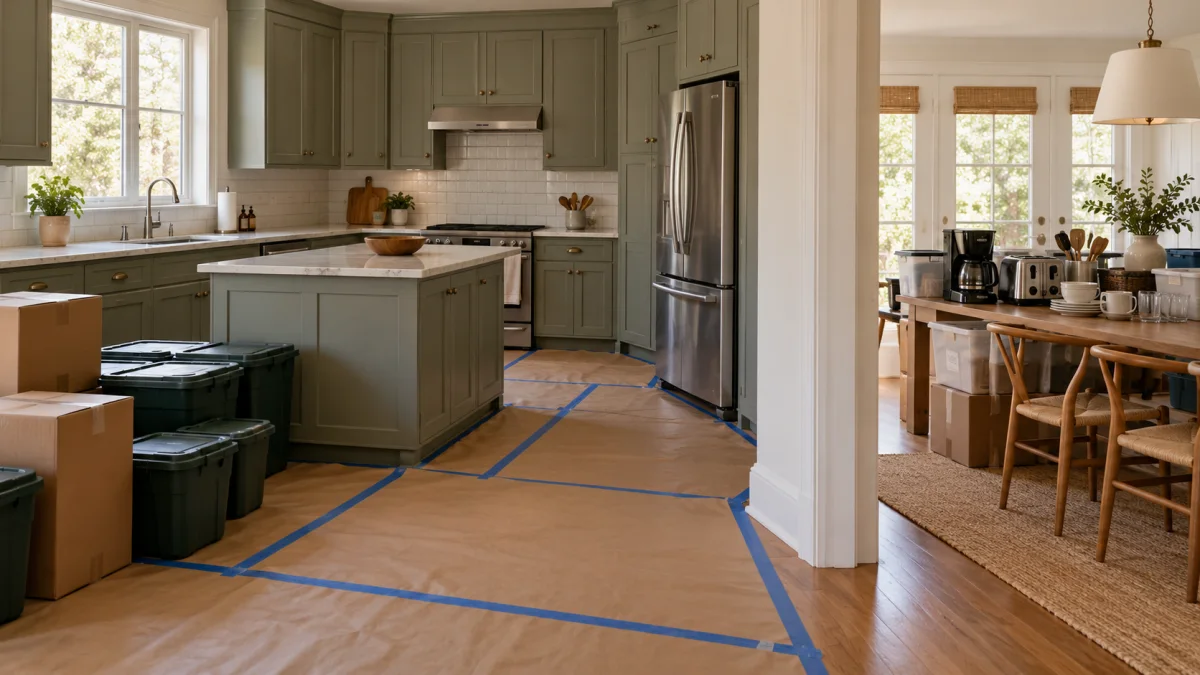
A kitchen demolition checklist should settle decisions before the room comes apart. Confirm what stays, what gets salvaged, who disconnects each utility, how the rest of the house is protected, and how hidden conditions become written changes. Demolition is a project handoff, not a homeowner test of how quickly cabinets can be removed.
This guide plans that handoff. It does not teach structural removal, electrical disconnection, plumbing disconnection, or appliance handling. The licensed independent professional you hire should inspect the room and assign those tasks.
Start with the final plan, not the demolition date
Demolition should follow an approved kitchen plan. It should not be the event that forces the plan into existence.
Bring these documents to the pre-demolition walkthrough:
- A measured layout showing every cabinet and appliance location
- The cabinet order or cabinet schedule
- Appliance specifications for the exact selected models
- Countertop, sink, faucet, backsplash, flooring, and lighting selections
- A list of walls, openings, plumbing, electrical, or ventilation changes
- The project’s permit path, when a permit may apply
- A written scope that names demolition, haul-out, protection, and cleanup
If the cabinet order is still changing, the room may not be ready to open. A revised refrigerator width or sink location can affect cabinets, counters, utilities, and flooring. Our guide to how long a kitchen remodel takes explains why design and ordering belong ahead of site work.
Building permits may be required depending on the scope. For a City of San Diego property, contact Development Services at 619-446-5000 about the actual address and work. Other cities and unincorporated areas use their own building departments. Do not copy a permit answer from a different address.
Make a keep, salvage, donate, and remove list
Walk the room with the contractor and label every major item. A short written schedule is clearer than pointing during demolition morning.
Use four decisions:
| Decision | Items to review | What the scope should say |
|---|---|---|
| Keep in place | Windows, doors, nearby flooring, appliances, or cabinet runs outside the work | How each item is protected and when access is needed |
| Salvage for reuse | Hardware, fixtures, appliances, shelves, or a cabinet chosen for another room | Who removes it, where it is stored, and its condition at handoff |
| Donate or transfer | Usable items that will leave the property intact | Who accepts them and who transports them |
| Remove and dispose | Cabinets, counters, backsplash, flooring, or debris included in the contract | Whether removal, loading, disposal, and site cleanup are included |
Do not call something salvageable without naming who takes responsibility for it. Removal can reveal damage that was not visible while an item was installed. The agreement should not silently turn a best-effort removal into a guarantee.
Photograph the room after it is emptied and before protection goes down. Capture cabinet interiors, appliance connections, walls, counters, flooring transitions, and adjacent finishes. Those photos create a shared record of the starting condition.
Confirm every utility and appliance handoff
The pre-demolition meeting should name who handles each appliance and utility. Avoid a broad note that says “disconnect as needed.”
Ask the contractor to identify responsibility for:
- Refrigerator, range, oven, microwave, dishwasher, and hood removal
- Sink, faucet, disposal, and dishwasher connections
- Existing receptacles, switches, lighting, and appliance connections
- Gas service, if the kitchen has a gas appliance
- Water shutoff planning and any period when household water may be affected
- Ventilation components that stay, move, or leave
This list is about coordination. It is not permission to disconnect any system yourself. Current electrical, plumbing, mechanical, appliance, and permit requirements depend on the property and scope. The contractor should explain which qualified professional handles each item.
For wider trade coordination, read our kitchen plumbing remodel guide and California kitchen electrical guide. Both keep unverified code numbers out of the plan and put address-specific decisions with the professional and permitting authority.
Protect the house outside the kitchen
Demolition affects the route into the room as well as the room itself. Mark the work path from the entry or loading point to the kitchen.
The written protection plan should address:
- Finished flooring along the work path
- Doorways, corners, stairs, and nearby cabinets
- The boundary between the work area and occupied rooms
- Tool and material staging
- Debris movement and the location of any container
- Daily cleanup and where the crew leaves the room
- Pets, children, and household access
If the home is occupied, set the temporary kitchen before site work starts. Move the refrigerator only after its next safe location and power source are confirmed. Pack daily dishes, food, medicine, pet supplies, and school items where construction traffic will not cross them. Our guide to living through a kitchen remodel covers the household side of that setup.
Condos and managed communities add building rules. Ask the owner or association for current access, elevator, parking, debris, and work-area requirements. Give those written rules to the contractor before the schedule is set. Modern Kitchen SD does not set or interpret association rules.
Decide how hidden conditions become changes
Cabinets and finishes can hide conditions that were not visible during the first walkthrough. The contract should explain what happens when demolition reveals something outside the agreed scope.
Before work starts, ask:
- Who documents the condition?
- What photos or written explanation will you receive?
- Who decides whether work pauses?
- How will added scope, materials, price, and schedule be approved?
- Which work can continue while that decision is open?
Do not approve an undefined allowance for every possible surprise. The original scope should be specific, and a real discovery should lead to a specific written change.
Keep the approved drawings, product selections, contract, change documents, and photos together. A text message can help the conversation. It should not be the only record of a changed scope.
Hold a final pre-demolition walkthrough
Use the last walkthrough to compare the room against the documents. Open every cabinet. Check every appliance label. Point to every surface that stays.
Confirm these items before authorizing site work:
- The final layout matches the cabinet and appliance documents
- Materials that must arrive before demolition are accounted for
- Permit and inspection responsibilities are named when applicable
- Keep, salvage, donate, and disposal decisions are written
- Utility and appliance responsibilities are assigned
- Protection and access routes are agreed
- The temporary kitchen is outside the work path
- The hidden-condition and change process is understood
- The contractor’s contact for site questions is identified
If a wall or opening will change, do not rely on a visual guess about structure. Start with our open-concept wall-removal guide, then have the appropriate professional evaluate the actual property.
Before you sign and pay
Verify the contractor through the CSLB License Check. License status confirms legal standing. It does not guarantee workmanship, so review the proposed scope and the CSLB hiring guidance as well.
For covered California home improvement contracts, Business and Professions Code section 7159 caps the down payment at $1,000 or 10 percent of the contract price, whichever is less. It is a statutory maximum, and a contractor may request less. Read the current statute and the complete agreement before paying.
Modern Kitchen SD is a referral service. We do not demolish kitchens, disconnect utilities, haul debris, or manage construction. Call (858) 400-4623 and we’ll connect you with a licensed independent local kitchen remodeler who can inspect the room and write a project-specific demolition scope. You contract with and pay that professional directly.