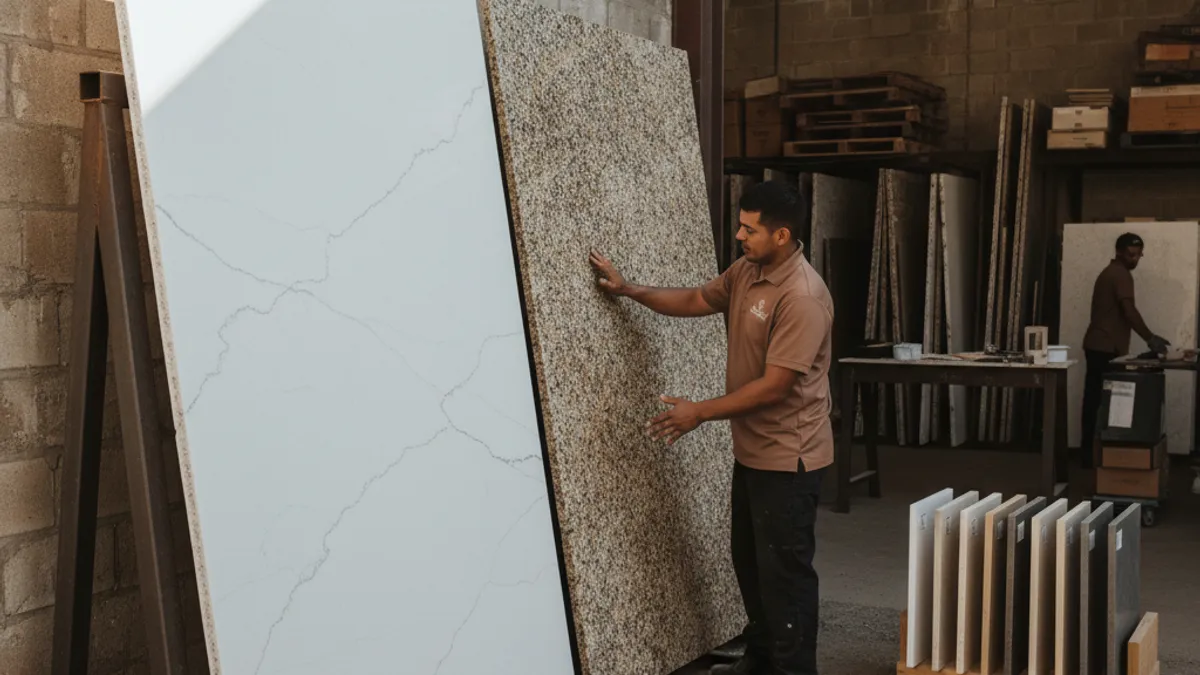
Quartz and quartzite share a name and not much else. Quartz, as Caesarstone and Cambria describe it, is an engineered slab. Quartzite, as the Natural Stone Institute describes it, is metamorphosed sandstone. One is a factory product with a published care guide. The other is a quarry slab whose porosity, hardness, and even identity have to be confirmed for that piece.
If you are still comparing granite, read quartz vs granite first, then come back for the quartzite side.
What quartz is
Caesarstone calls quartz a man-made surface engineered with up to 90% quartz minerals, 92% at the high end of its published blend. Cambria describes a natural-quartz product that is stain resistant, nonporous, and nonabsorbent, and says it never needs sealing, polishing, or reconditioning.
From those two care pages:
- Daily cleaning is warm water, a soft cloth, and mild soap if you want it.
- Do not apply sealers, penetrants, or topical treatments to Cambria.
- Caesarstone says the surface is highly nonporous and does not host bacteria, mold, or mildew. Wipe spills so residue does not dry into a film, especially on dark colors.
- Heat is the line both makers draw. Cambria says it is not heat-proof, chemical-proof, or fracture-proof. Use a closed-weave hot pad or a solid trivet under cookware and heat-producing appliances. Caesarstone says to always use a trivet or hot pad and a cutting board.
Those rules belong to those brands. Another quartz line can forbid different cleaners or limit outdoor use. Caesarstone sells a separate outdoor collection, which is a reminder that indoor quartz is not automatically approved for sun. Ask for the current care guide for the color on the quote.
Cambria also limits thickness: 2 cm and 3 cm for countertops, 1 cm for vertical work. The slab is not structural. Cabinets have to be sound, level, and square or the seams and overhangs suffer.
What quartzite is
The Natural Stone Institute’s quartzite care article describes quartzite as metamorphosed sandstone. Looks often get compared to marble. Care, in that article, is closer to granite: a gentle cleanser, water, and a soft cloth; wipe spills; use coasters, trivets, cooling racks, and a cutting board.
Two properties get people in trouble if they treat every slab as the same stone.
Hardness. Stone professionals quoted by the Institute say true quartzite is nearly twice as hard as glass and harder than a knife blade. That is why a cutting board still matters: the stone can dull the knife. Hardness also means fabrication can take longer and wear tooling, which can show up in the labor line of a quote.
Porosity and sealing. The Institute says an impregnating sealer can increase stain resistance, and that the need ranges from none at all to sealing at install and again later. It names more porous quartzites, including White Macaubas and Calacatta Macaubas, as stones that may benefit from sealer. Watch the sink area. If the stone darkens from water, the slab may need sealer or the current sealer may be fading. Clean and dry the stone completely before any sealer goes on. The fabricator or supplier should name the product for that slab.
Acid resistance belongs only to true quartzite. The Institute says quartzite is resistant to common kitchen acids and will not etch from lemon juice or vinegar. That sentence does not apply to a slab that was sold as quartzite and is actually marble.
The labeling problem, without a kitchen-sink test
The same Institute article is blunt: some stones are sold as quartzite or “soft quartzite” when they are marble or dolomitic marble. Homeowners call restorers after etch marks appear. Geologist Karin Kirk, quoted there, puts it as consistent properties and variable labeling.
Do not drip lemon juice, vinegar, or wine on a slab in a stone yard to “prove” it. You may not own that slab. You can stain or etch someone else’s material. You can also misread a dirty, already-sealed, or honed sample.
What to do instead:
- Ask the seller to state the geological identity of the exact bundle and slab numbers in writing.
- Ask the fabricator how they confirm quartzite versus marble before they template.
- If you want a third opinion, hire an independent stone professional. The Institute publishes a member directory for that purpose.
- Compare the written identity to the care card. A marble care card on a “quartzite” quote is a stop sign.
True quartzite, in the Institute’s description, does not etch, is not easily scratched with a knife, and will scratch glass. Those are professional checks, not a DIY afternoon on a slab you have not paid for.
Heat, chips, and UV
Do not put a hot pot on either surface because an article said it was safe.
Quartz: Cambria and Caesarstone require trivets. Cambria warns that direct or sustained heat, and sudden temperature change near edges, can damage the product.
Quartzite: the Institute still wants trivets and cooling racks. Hardness is not a warranty against thermal shock, a cracked edge, or a finish change. Follow the fabricator’s care card for that slab.
Chips happen on both. Cambria says no stone is chip-proof, and that hits at sink and dishwasher edges are the usual story. Quartzite’s hardness does not make an outside corner immortal. Ask who repairs a chip and whose warranty covers it.
Sun and marine air are not a reason to pick a winner from a map of San Diego neighborhoods. Outdoor approval, UV limits, and cleaner chemistry are written on the product or sealer documents. Indoor quartz is not automatically outdoor quartz. A sealed quartzite is not automatically a patio top. Ask for the indoor/outdoor statement that matches the exact material.
How to choose
Choose quartz if:
- You want a factory-controlled look and a published no-sealer care guide from that brand.
- You will use trivets and the cleaners the manufacturer allows.
- You have compared the full slabs, not just a chip, and you accept visible seams.
Choose quartzite if:
- You want a natural slab and you have written confirmation that the slab is quartzite, not marble.
- You will follow a slab-specific sealing and cleaner plan.
- You will use trivets and a cutting board anyway.
- You have seen the actual slabs that will be cut, including the areas that will land at the sink and the seams.
There is no universal “more durable.” Quartzite’s hardness helps against some scratches and, when the stone is genuine, against etching. Quartz’s nonporous resin body, in Caesarstone and Cambria’s telling, is the stain and sealing story. Each product can chip, stain, or discolor when it is used against its care guide.
What to ask the fabricator
Our kitchen countertop installation page covers templating and the install sequence. Before that stage, put these answers in the quote:
- What is the written identity of this exact quartzite slab, or the quartz brand, color, and thickness?
- Where is the current care guide, and what cleaners and heat rules does it name?
- For quartzite, what sealer will be used, and what reapplication plan belongs to this stone?
- How will the templates be laid out, and where will seams fall?
- What fabrication and installation warranty applies, and what does it exclude?
Prices move with rarity, thickness, edge work, cutouts, and seams more than with the word “quartz” or “quartzite.” We do not publish local installed ranges. Compare complete written scopes. For how this choice sits in a larger budget conversation, see kitchen remodel costs in San Diego.
Call (858) 400-4623 and tell us which slab or quartz color you are looking at. We match homeowners across San Diego County with licensed independent remodelers. You contract and pay that professional directly.
Frequently asked questions
Is quartzite better than quartz?
Neither is better in every kitchen. Quartzite is a natural stone with hardness and, when genuine, acid resistance described by the Natural Stone Institute. Quartz is an engineered surface whose stain and sealing story comes from the brand’s care guide. Daily habits, the exact slab or color, and the written warranty decide the better fit.
Does quartzite need sealing?
Sometimes. The Institute says it depends on that stone’s porosity. Some quartzites may not need sealer. Others, including named porous varieties, may need it at install and later. Ask the fabricator for this slab, not for “quartzite” as a category.
What about quartz vs quartzite cost?
We do not publish a San Diego price band. The quote follows the slab, the layout, the edge, the cutouts, and the labor of cutting a harder stone. Ask for like-for-like written proposals.
Which is more durable?
Define the failure you care about. True quartzite is described as very hard and acid resistant. Engineered quartz is described by Caesarstone and Cambria as nonporous and stain resistant, and not heat-proof. Edges chip on both. Follow the care card.
Can you put a hot pot on quartzite?
Do not. The Institute recommends trivets for natural stone. Quartz manufacturers require them. A hot pan is a warranty and a crack risk, not a party trick.
Should I cut directly on quartzite?
No. The Institute notes that quartzite can dull knives. Cambria and Caesarstone want cutting boards on quartz. Use a board on both.