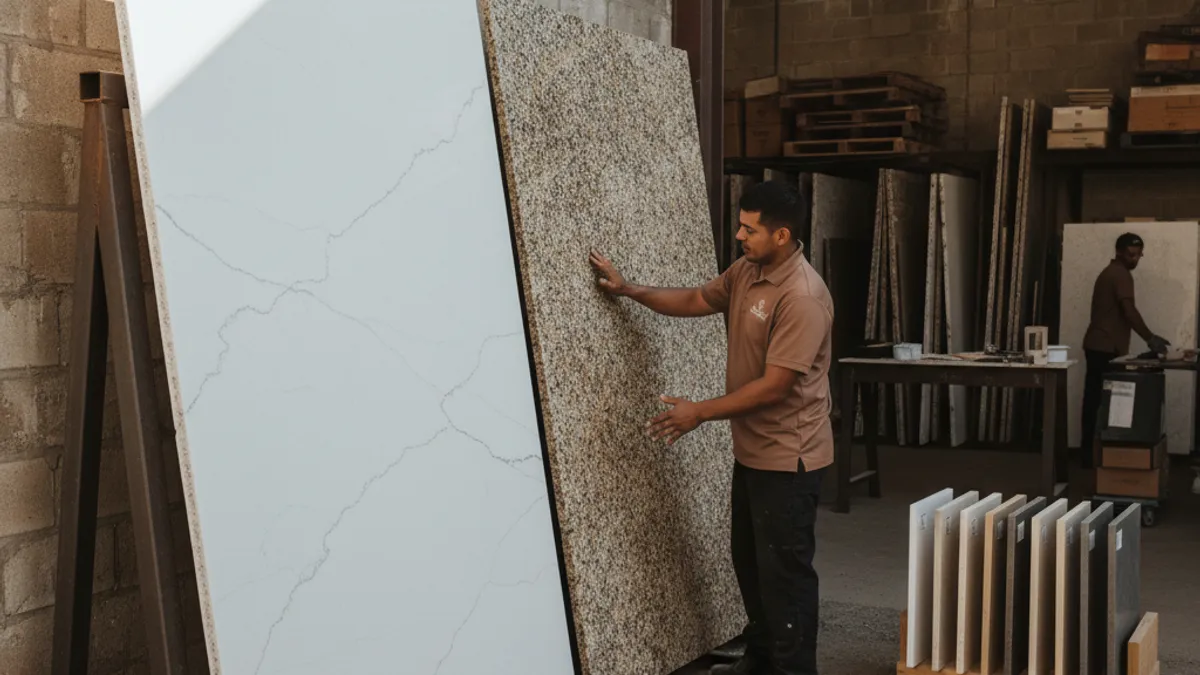
Quartz and granite can both work in a San Diego kitchen. The useful comparison is product-specific. Caesarstone and Cambria publish care rules for their quartz. The Natural Stone Institute publishes care rules for natural stone, including granite. Those documents disagree with the internet habit of putting a hot pan on either surface and calling the job done.
If you are also weighing natural quartzite, start with our quartz vs quartzite comparison after this one.
What quartz is, according to the makers
Caesarstone describes quartz countertops as an engineered surface made with up to 90% quartz minerals, with its highest published blend at 92%. The rest of the slab is the binder and pigment system that makes the pattern repeatable. Cambria describes its product as created from natural quartz stone, with color and pattern variation still present from slab to slab.
What follows from those manufacturer pages:
- Caesarstone calls the surface nonporous and says it does not need sealing. Daily care is warm soapy water, then a rinse and a dry cloth.
- Cambria says its quartz never requires sealing, polishing, or reconditioning, and calls the surface nonporous and nonabsorbent.
- Cambria also says, in plain language, that Cambria is not heat-proof, chemical-proof, or fracture-proof. Use a closed-weave hot pad or a solid trivet under pots, pans, electric frying pans, griddles, slow cookers, air fryers, roaster ovens, and heat lamps.
- Caesarstone’s care page says to always place hot cookware on a trivet or hot pad, and to always use a cutting board.
Do not treat those rules as true for every quartz brand. Silestone, MSI, and other lines publish their own manuals. Read the current care guide and warranty for the exact color you are buying.
Cambria also publishes thickness limits that matter at quote time: 2 cm and 3 cm for countertops and other horizontal surfaces, 1 cm for vertical finishes such as walls and full-height backsplash. The slab is not a structural member and has to be supported in every application.
What granite is, according to stone-care sources
Granite is a natural igneous stone. The Natural Stone Institute groups it with siliceous stones, meaning it is composed primarily of silicates such as quartz, feldspar, and mica. That mineral mix is why no two slabs look the same, and why you should pick the actual slab rather than a small sample chip.
The Institute’s care guidance, and its granite article on Use Natural Stone, is more cautious than showroom talk:
- Use coasters under glasses, especially those with alcohol or citrus.
- Use trivets or mats. The Institute says many stones can withstand heat, and still recommends trivets.
- Use a cutting board.
- Clean with a neutral cleaner, a stone soap, or a mild liquid dishwashing detergent and warm water. Blot spills. Do not spread them.
- Stone-care professionals quoted in that granite article warn that ordinary dish detergent can leave a greasy film. They prefer a residue-free stone cleaner.
Sealing is not a yearly law. The Institute says the products used in the trade are impregnators. They make stone more stain resistant. They do not make it stain-proof. Many stones do not require sealing. The granite article says some colors, such as Absolute Black, may not need sealer or may need only one application, while more porous granites may need several. The fabricator or sealer manufacturer should set the product and the interval for your slab.
If you want a field check later, the same article describes a water test used by restorers: a little hot water, 10 to 20 minutes, then wipe. Darkening means the stone is still absorbing moisture. That test is about sealer status, not about identifying the rock.
Heat, stains, and what not to do
Neither source gives permission to set a hot pan directly on the counter.
Cambria’s care page is the clearest quartz warning: sudden or rapid temperature change near edges, and direct or sustained heating, can damage the surface. Caesarstone is shorter and just as firm: trivets and hot pads, always.
For granite, the Institute still wants trivets. Heat resistance in a quarry is not the same thing as thermal shock at a sink edge or a warranty that covers a scorch. Follow the fabricator’s written care card for that slab.
Stain behavior is also not a universal winner. Caesarstone and Cambria sell nonporous quartz and tell you to wipe spills so residue does not sit and form a film, especially on dark colors. Granite’s stain risk depends on the slab’s porosity and whether an impregnator is in place. Oil, wine, and coffee are named stain types in the Institute’s stain notes. Blot, then use the method that matches the stain family. Do not improvise with lemon, vinegar, or a granite-specific cleaner on quartz, or with a quartz cleaner on granite, unless that product’s label allows it.
Cambria forbids bleach, oven cleaners, Comet, Soft Scrub, S.O.S. pads, pumice, paint removers, and any sealer or topical treatment. Caesarstone warns against oven and grill cleaners, floor strippers, toilet-bowl cleaners, oil soaps, and products with trichloroethane or methylene chloride. The Institute warns that lemon, vinegar, and other acids can dull calcareous stones, and that hydrofluoric acid in some rust removers attacks granite and quartzite. Read the care card that ships with your surface.
A comparison you can take to a slab yard
| Topic | Quartz, using Caesarstone and Cambria | Granite, using Natural Stone Institute care | Still product-specific |
|---|---|---|---|
| What it is | Engineered slab; Caesarstone cites up to 90% quartz minerals, 92% at the high end | Natural siliceous stone: quartz, feldspar, mica | Other quartz brands publish their own mix |
| Look | More controlled pattern; Cambria still warns that samples do not show the full slab | Unique movement; pick the actual slab | Bookmatching, seams, and finish change the result |
| Sealing | Cambria: never apply a sealer. Caesarstone: no sealing | Impregnator if that slab needs it; not stain-proof | Ask for the sealer name and interval in writing |
| Heat | Not a hot-pan surface. Trivets required | Trivets recommended even when the stone can take heat | Warranty exclusions vary by brand and fabricator |
| Daily clean | Mild soap and water, then dry | Neutral stone cleaner or mild detergent, then rinse and dry | Finish (polished, honed, matte) changes how marks show |
| Chips and scratches | Cambria: no stone is chip-proof or scratch-proof; edges at sinks and dishwashers are vulnerable | Deeper scratches belong to a stone professional | Repair method depends on color, finish, and who warrants the work |
| Outdoor or sun | Caesarstone sells a separate outdoor collection. Indoor quartz is not automatically approved outside | Follow the stone supplier for that slab and finish | Do not copy indoor care onto an exterior counter |
Cost is not in this table on purpose. We do not publish San Diego installed price bands. Complexity, edge profile, sink and cooktop cutouts, seams, and the rarity of the slab move the quote more than the material name. Compare written proposals that list the same scope.
How to pick a slab and a fabricator
Three habits keep the comparison honest:
- See the full slab. Cambria says samples are small select cuts and may not show all of the design. Granite has the same problem, only more so. Reserve the actual slabs that will be cut.
- Ask for the current care guide and warranty in writing. Caesarstone publishes a lifetime product warranty on its site. That is Caesarstone’s warranty, not a promise from Modern Kitchen SD, and it is not granite’s warranty. Granite typically carries fabricator workmanship terms, not a quarry warranty. Read exclusions for heat, chemicals, chips, and outdoor use.
- Get a templating and seam drawing before fabrication. Cambria notes that seams are visible and that pattern and shade change across a seam. Ask where seams will fall, who templates, and who installs.
Our kitchen countertop installation page covers the line items that belong in a complete quote. For how the counter choice sits inside a larger project, see full kitchen remodel.
Edge profiles, other materials, and the decision
Edge names vary by shop. An eased edge, a bevel, a bullnose, and a mitered build-up are different shapes, different labor, and different places for chips. Approve the profile on a sample of the same material and thickness. Do not treat a style pairing (shaker with eased, slab door with waterfall) as a rule.
Marble, butcher block, quartzite, and porcelain slabs are separate products with their own care cards. Do not borrow quartz or granite advice for them. Quartzite is covered in the quartz vs quartzite guide.
Choose quartz when you want a factory-controlled look and you will follow that brand’s no-sealer, trivet, and cleaner rules. Choose granite when you want a unique natural slab and you will follow the sealing and care plan for that stone. Either choice still depends on the room, the cook, and the written documents. A photo on a phone is not enough.
Call (858) 400-4623 and we will match you with a licensed independent kitchen remodeler. You contract and pay that professional directly. Bring the brand, color, and care sheets you are considering so the quote can follow those documents instead of a generic material speech.