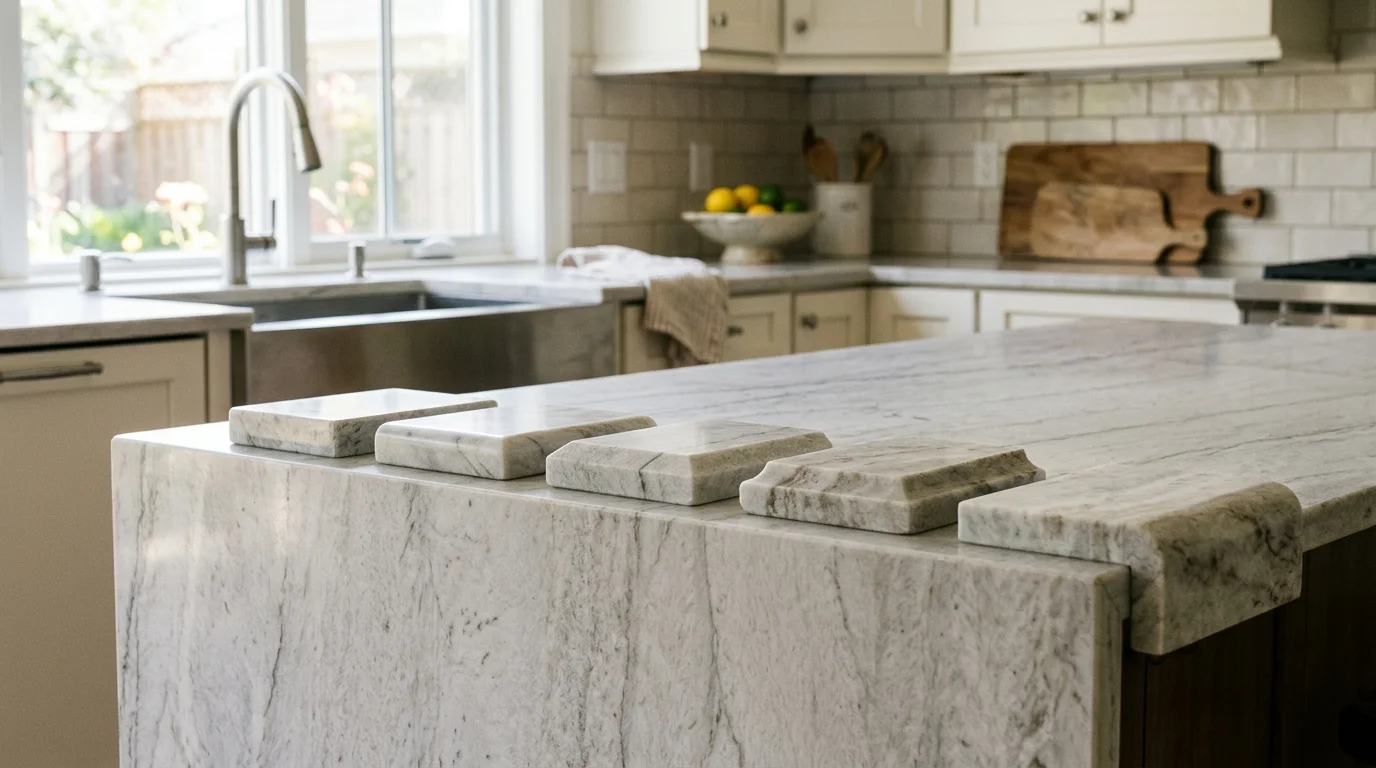
Edge samples can appear similar until they’re beside your cabinets. Their curves, angles, and apparent thickness can change the whole counter. We couldn’t confirm fixed San Diego prices for these profiles, so request a written quote for the exact edge you select.
The standard profiles, plainly described
Edge names aren’t always used consistently between showrooms and fabrication shops. Bring a photo, then ask for a labeled drawing and physical sample. The drawing matters more than the sales label.
Eased or softened square: This profile keeps a mostly straight face. The upper and lower transitions receive subtle softening. It suits homeowners who want the countertop material to remain the focus.
Beveled: A bevel places an angled strip along the edge. A narrow bevel reads as restrained. A broader bevel becomes a stronger design line. Ask to see the exact angle and width before approving it.
Pencil: This name usually describes a small, rounded transition. However, the finished shape can vary by fabricator. Compare the shop’s sample with the drawing rather than relying on the name.
Bullnose: A bullnose creates a rounded face from top to bottom. It can soften the appearance of an exposed counter or island. Check its underside in person, since that area remains visible from nearby seats.
Half-bullnose: The upper portion is rounded while more of the face stays straight. It gives you a curved top without the fully rounded appearance of a bullnose.
Ogee: An ogee has a more decorative, sculpted outline. Its curves cast stronger shadows than a plain edge. It often makes the most sense when the cabinets and other details carry similar visual weight.
Mitered or built-up: This treatment creates the appearance of a deeper countertop face. Ask how corners, seams, and pattern alignment will look in your selected material.
A waterfall is different from these profiles. The term describes countertop material continuing down a cabinet end. Its exposed edge still needs its own profile decision.
The pro handling your kitchen countertop installation can show which shapes are available for the chosen material. Don’t approve the selection from a distant showroom photo.
Which edges cost extra and why
There isn’t a verified countywide price schedule for countertop edge profiles. Modern Kitchen SD doesn’t set prices. Ask the matched professional or fabricator to provide current pricing for each option. That means an honest comparison can’t assign a dollar amount to any profile.
Use this cost status for each common choice:
| Profile | Verified San Diego cost | What to ask |
|---|---|---|
| Eased or softened square | Not confirmed | Is this included in the quoted fabrication? |
| Beveled | Not confirmed | Does the selected angle change the quote? |
| Pencil | Not confirmed | What exact shape does this shop call pencil? |
| Bullnose | Not confirmed | Is shaping and polishing shown separately? |
| Half-bullnose | Not confirmed | Is the entire exposed run included? |
| Ogee | Not confirmed | Are corners and short returns included? |
| Mitered or built-up | Not confirmed | Are seams, corners, and pattern matching included? |
A profile described as “standard” isn’t automatically included in your proposal. Ask the matched pro or fabricator to identify the base edge in writing. Then request a separate line for any upgrade under consideration.
The quote should also identify every exposed run and corner. An island may have more visible edges than a wall counter. A short return beside a range or refrigerator can be overlooked during an early conversation. Mark those locations on the countertop plan.
Don’t use another homeowner’s invoice as a local price guide. A quote from Encinitas doesn’t establish a fixed rate in El Cajon. Materials, drawings, exposed sections, and shop terms may differ.
Compare proposals using the same profile drawing. “Ogee” on one quote and “decorative edge” on another isn’t a clean comparison. Ask both professionals to price the same marked plan and sample. That gives you a useful answer without relying on an invented average.
Edges that are hard on kids and hips
No countertop profile carries a guaranteed safety rating, and no edge can prevent injuries. Treat comfort as an in-person design test. This matters most around islands, peninsula ends, tight passages, and corners beside frequently used seats.
Start by locating every outside corner on the plan. Stand where people will walk, sit, open drawers, and carry dishes. Notice whether an edge or corner enters that path. The room layout can matter more than the profile’s name.
Next, handle full-size samples. Run your palm over the top transition, face, lower edge, and corner. A profile that looks soft in a photo may still have a lower detail you dislike. A strongly beveled or decorative sample may feel different from its straight-on image.
Rounded profiles are reasonable samples to test when contact comfort is a priority. Still, don’t assume a bullnose label makes every corner suitable. Ask to see the proposed outside-corner treatment. The corner drawing should show how two profiled edges meet.
Counter height also affects where the edge reaches someone’s body. Confirm the planned dimensions instead of relying on an existing counter. Our guide to standard kitchen counter height explains the measurements to review with the designer.
For a household with young children, discuss corner placement with the matched professional. You can also ask whether an exposed end can be reshaped, relocated, or treated differently. Get the final decision added to the drawing before material is fabricated.
Comfort is personal. Test samples with the people who use the kitchen rather than choosing from a catalog page.
Matching the edge to the slab thickness
The profile and slab thickness need to be considered together. A showroom sample can mislead when its thickness, color, pattern, or finish differs from your selected surface. Ask for a sample that represents the planned installation as closely as possible.
Begin with the actual material specification. Then request a scaled edge drawing from the professional preparing the countertop. The drawing should show the top, face, underside, and any added build-up. It should also identify visible seams.
This step clears up a common source of confusion. A thick-looking face may be a different construction than the sample beside it. Ask whether the appearance comes from the slab itself or a mitered build-up. Don’t assume the difference from a photograph.
Material choice can also affect which profiles a particular fabricator offers. We couldn’t confirm profile limits for stone, quartz, porcelain, laminate, or other surfaces. Confirm availability with the professional and the manufacturer’s specifications for your chosen product.
Pay close attention to transitions. The edge has to look intentional beside cabinet doors, finished panels, sink openings, and appliance gaps. Ask for a detail drawing wherever one edge treatment meets another.
An island deserves a full walk-around review. Look at the face from standing and seated positions. Check the corners and the underside. If the island uses a waterfall panel, confirm how its joint relates to the horizontal edge.
Bring cabinet samples into the decision when possible. A quiet edge can balance detailed doors. A sculpted profile can become another strong visual element. Neither approach is automatically correct. The better match is the one shown together before approval.
A kitchen design consultation can coordinate these choices before the countertop order is finalized.
Picking an edge you won’t regret
Choose the edge as part of the entire counter plan, not as a showroom add-on. The most reliable approval combines a named profile, a drawing, a physical sample, and a written quote.
Use this short review before signing:
- Mark every exposed edge. Include islands, peninsula ends, sink runs, and short returns.
- Label every profile. Don’t leave the drawing with a vague note such as “decorative edge.”
- Approve the outside corners. Their treatment may not be obvious from a straight sample.
- Confirm the visible thickness. Compare the drawing with nearby doors and finished panels.
- Get the cost in writing. Ask what’s included and what changes the quoted amount.
- Save the approved sample details. Keep the profile name, drawing, material, finish, and revision together.
Think about cleaning without assuming one profile is maintenance-free. Handle the sample and inspect its curves, grooves, and underside. Decide whether you’re comfortable wiping that shape around cooking and preparation areas.
Use restraint when several features already compete for attention. Cabinet door details, backsplash patterns, hardware, veining, and an ornate edge can all occupy the same sightline. Set the samples together inside the actual room before choosing.
Also consider where the edge changes. A decorative island with simpler perimeter counters can work visually, but the transition should appear on the drawings. Ask for each profile to be named separately in the proposal.
Modern Kitchen SD matches homeowners across San Diego County with licensed, independent kitchen remodel professionals. The customer contracts with and pays the professional directly. Before hiring, California homeowners can verify a contractor through the CSLB License Check.
The final decision doesn’t need to follow a trend. It needs to look right with your slab, cabinets, room proportions, and exposed corners. A clearly documented choice is easier to price, compare, and approve.
When to call us
When edge selection affects slab fabrication, cabinet support, sink fit, or a larger remodel, work with a licensed kitchen remodeling pro. Modern Kitchen SD can match you with an independent professional serving San Diego County. Call us at (858) 400-4623 and we’ll connect you with a licensed local kitchen remodeler.