The most useful corner cabinet solutions bring stored items toward you. Lazy Susans, blind-corner pullouts, corner drawers, and diagonal cabinets each solve that problem differently. The right choice depends on your cabinet opening, aisle space, and daily storage needs.
Why blind corners waste so much space
A blind corner forms where two cabinet runs meet. Part of one cabinet continues behind the neighboring run. The interior may be deep, but the door exposes only part of it.
That mismatch creates the real problem. Storage capacity matters less when you can’t see or reach what’s inside. Small containers drift toward the back. Heavy appliances become awkward to retrieve. Eventually, the deepest area may stop being useful.
Start by identifying what frustrates you now. Empty the cabinet and sort its contents into three groups:
- Items you use every week
- Items you want nearby but use less often
- Items that belong somewhere else
Next, look at the cabinet opening and the surrounding doors. An organizer must pass through that opening without hitting a range, dishwasher, or neighboring handle. It also needs room to move into the aisle.
Don’t judge a solution only by how much it claims to hold. Consider whether every shelf remains visible and reachable. A smaller organizer that comes fully forward may serve you better than a larger shelf hidden behind a narrow door.
The cabinet box also matters. Face frames, hinges, plumbing, and shelf supports can affect which organizer fits. A cabinet professional should measure the opening and interior before anything gets ordered. For a remodel built around the exact room, explore custom kitchen cabinets and built-ins.
Lazy susan versus blind corner pull out
A lazy Susan uses rotating shelves inside a corner cabinet. You turn the shelf until the item you need reaches the door. Some versions sit behind a diagonal door. Others use doors that fold or move with the rotating assembly.
This approach keeps the motion inside the cabinet. It can suit an aisle where a large organizer would block movement. The open shelf shape also makes bulky cookware easy to spot. Containers near the outer edge need stable placement so they don’t interfere with rotation.
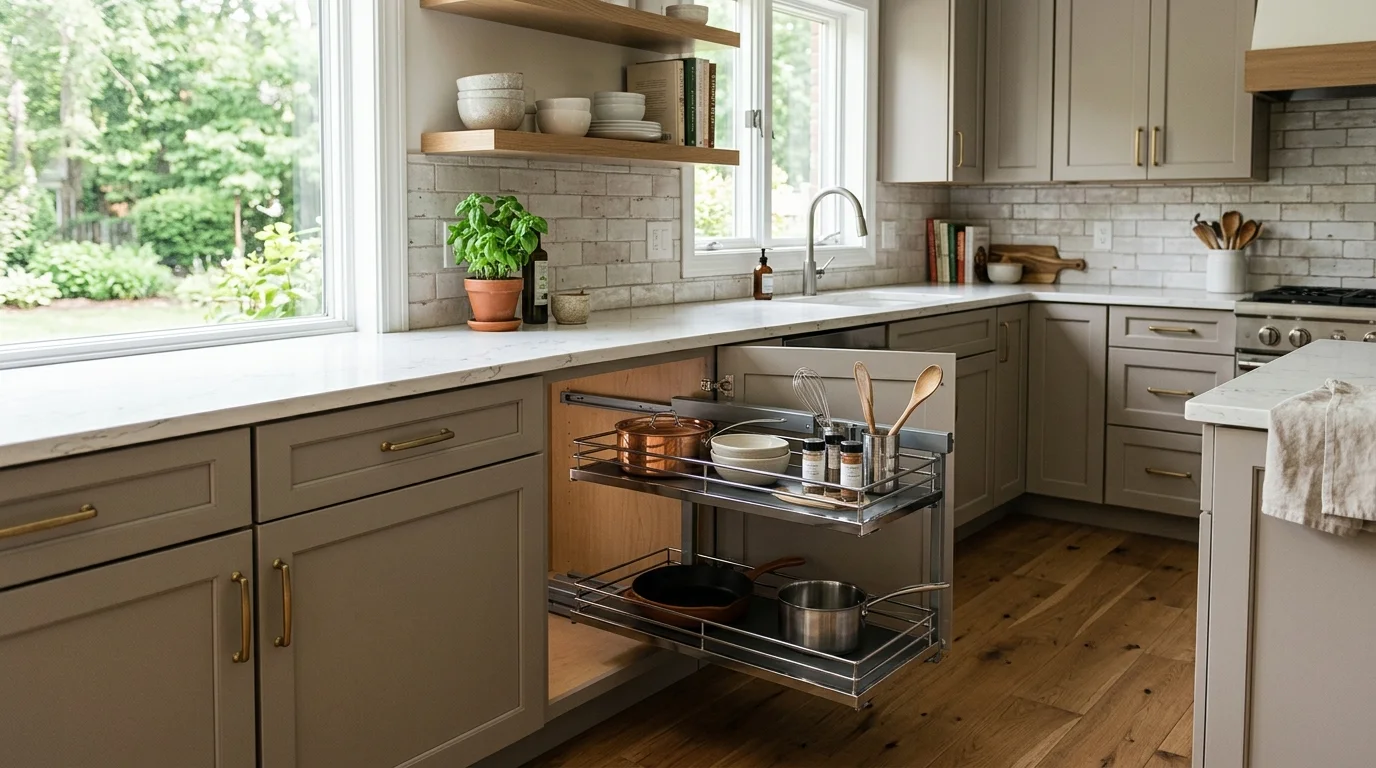
A blind-corner pullout works differently. Its shelves or baskets move through the cabinet opening. Depending on the hardware, one section may slide toward the door while another comes forward from the hidden corner.
That motion can make the back section easier to inspect. It also places more of the organizer in the aisle while open. Check how that movement interacts with the opposite cabinets, an island, and anyone walking through the kitchen.
Compare both options with the items you’ll actually store. Pots, mixing bowls, countertop appliances, food containers, and pantry goods create different demands. A rotating shelf may suit broad items. A pullout may help when you want defined baskets and a clear view of each section.
Before choosing, ask for the hardware manufacturer and model. Review its cabinet requirements, listed capacity, door configuration, and care instructions. Confirm that the proposed cabinet matches those specifications. A product demonstration is even better. Open it fully, load representative items, and notice whether the movement feels natural.
Corner drawers and diagonal cabinets
Corner drawers replace the usual door with drawer fronts that meet at the corner. Behind those fronts, shaped drawer boxes travel outward on slides. Each drawer can hold a separate category, which reduces the need to reach through one deep cabinet.
They can also create a more continuous drawer layout. That may appeal when nearby cabinets already use wide drawers for cookware and utensils. The tradeoff is the unusual drawer shape. Some interior space follows the corner angle, so test whether your intended items fit comfortably.
A diagonal cabinet takes another approach. Its face spans the corner at an angle. That creates a direct opening into the corner instead of hiding the interior behind an adjacent cabinet. The design can be used above or below the counter, depending on the cabinet plan.
The angled face changes the room visually. It may soften a tight turn, or it may feel bulky beside straight cabinet runs. Door swing and countertop shape deserve attention. Ask to see the cabinet in a scaled plan and from standing eye level, not just from above.
Open shelves are another possible treatment for an upper corner. They keep everyday dishes visible and avoid competing cabinet doors. They also put every stored item on display, which isn’t right for every household.
A slim corner drawer might fit one San Diego kitchen, while a diagonal cabinet may suit another. A North Park galley and a Chula Vista family kitchen shouldn’t receive the same answer by default. The room’s actual measurements should lead the decision.
Cost of each solution
A standard San Diego price for these corner cabinet solutions could not be confirmed. Modern Kitchen SD doesn’t set contractor prices. Confirm current product and installation costs through written quotes from licensed independent professionals.
Compare the same scope in every quote. A hardware price alone won’t show what the completed cabinet will cost. Ask each professional to identify the cabinet box, organizer, installation labor, finish work, and any nearby cabinet changes.
For each option, request different details:
- For a lazy Susan, confirm the shelf system and required door style.
- For a blind-corner pullout, request the exact hardware model and cabinet requirements.
- For corner drawers, ask whether the drawer boxes come from the cabinet line or require custom fabrication.
- For a diagonal cabinet, confirm the door, interior shelves, and countertop treatment.
- For an untouched blind corner, identify what storage remains accessible.
Don’t assume the simplest-looking option has the lowest installed cost. Cabinet construction, finish matching, and modifications can change the quote. The clearest comparison uses the same material, finish, and project boundaries.
Also ask how replacement parts are handled. Slides, hinges, baskets, and rotating hardware come from different manufacturers. Keep the product information with your remodeling records.
For covered California home improvement contracts, Business and Professions Code §7159 caps the down payment at $1,000 or 10 percent of the contract price, whichever is less. That’s the statutory maximum, and a contractor may request less. Review the complete contract before paying or authorizing work.
Layouts that avoid the corner entirely
The cleanest corner solution can be a layout without a corner cabinet. A one-wall kitchen keeps cabinets on a single straight run. A galley places storage on parallel walls. Either approach can remove the deep intersection that creates a blind corner.
Another option ends one cabinet run before the adjoining wall. The open area might hold a freestanding item, a small table, or clear circulation space. Storage lost from that corner can sometimes move into taller cabinets, wider drawers, or an island.
Don’t force cabinets into every available inch. A packed floor plan may create door conflicts and narrow movement paths. Compare storage access while drawers, appliances, and cabinet doors are open. The closed plan shows appearance. The open plan shows how the kitchen behaves.
In a smaller room, start with the tasks that need support. Food preparation, cleanup, cooking, and pantry storage should each have a practical home. Our small kitchen remodel ideas explain more ways to prioritize useful storage without crowding the plan.
A measured design can compare a blind corner with a revised cabinet run. It can also show how each choice affects countertops, appliance placement, and circulation. Our kitchen design and 3D render service connects homeowners with local professionals who can develop those alternatives.
Permits may be required depending on the project scope. For work within the City of San Diego, check with Development Services about the current requirements for your plan. Homeowners elsewhere in San Diego County should contact their local permitting authority.
When to call us
Corner cabinet work needs a licensed kitchen remodeling pro when cabinet fit, hardware movement, and surrounding layout changes must be coordinated. You can verify a contractor through the CSLB License Check before signing a contract. Call us at (858) 400-4623 and we’ll connect you with a licensed local kitchen remodeler.