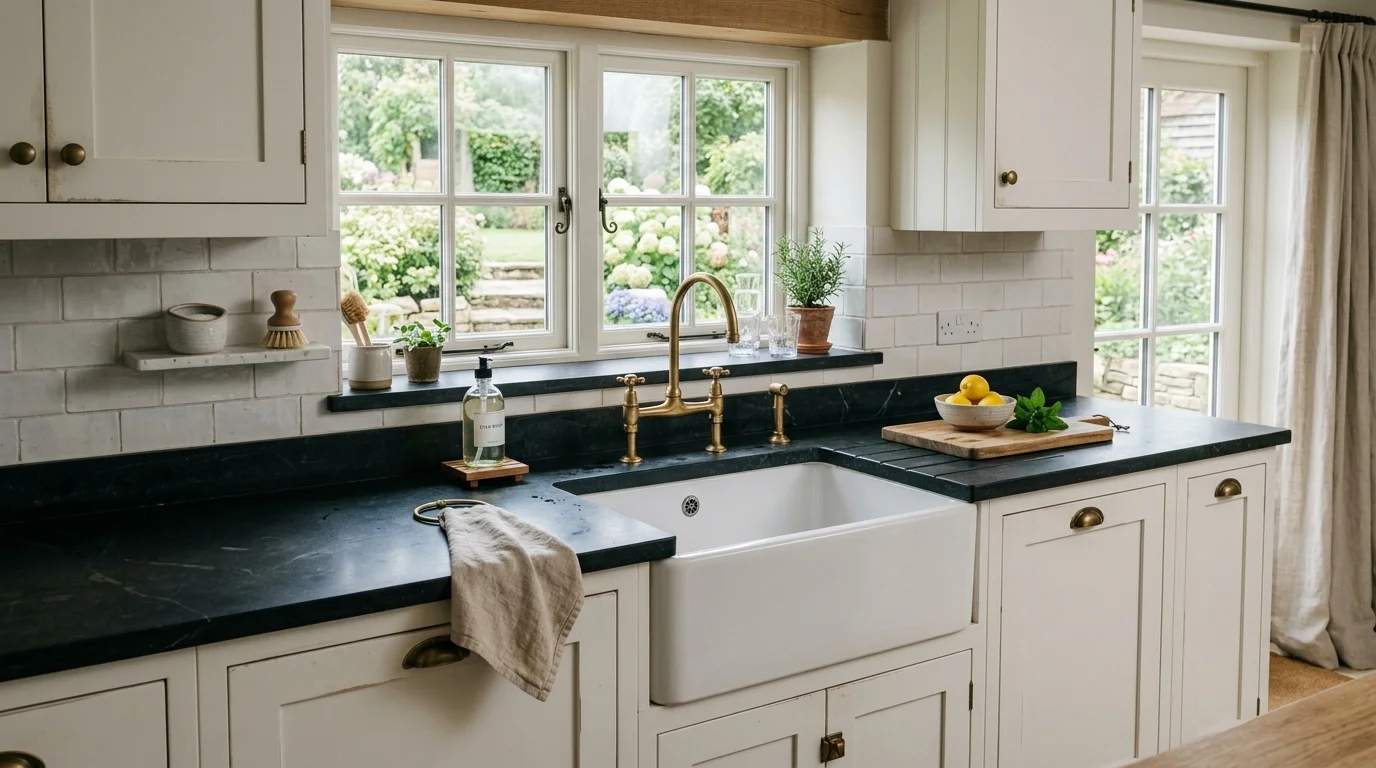
Soapstone countertops make a specific design statement, but the material name alone doesn’t settle the decision. Choose the exact slab, demand written performance details, and decide whether the seller’s definition of patina fits your kitchen.
What soapstone is and how it behaves
The U.S. Geological Survey treats soapstone as a rock, not a single mineral. USGS’s talc fact sheet FS-065-00 and its talc commodity page state that talc is a hydrous magnesium silicate, formula Mg3Si4O10(OH)2, and the softest mineral on the Mohs scale (1). A massive talcose rock is called steatite. An impure massive variety is called soapstone. Weak bonds between talc platelets give the greasy, soapy feel. USGS also lists chemical inertness and high thermal conductivity among talc’s commercial properties. Those mineral facts explain the kitchen reputation: the surface feels soft, it can take heat better than many stones, and it scratches and darkens with use.
The Natural Stone Institute still puts soapstone in the natural-stone care family. NSI’s general stone guidance is a neutral cleaner, trivets, and prompt spill cleanup. Oil, wax, or sealer on soapstone is a supplier decision. Some slabs are sold with a mineral-oil routine that deepens color. Others are left to develop a dry patina. Neither routine is universal. Get it in writing for the quoted slab.
| Typical soapstone tendency (USGS + supplier care) | Watch-outs | |
|---|---|---|
| Feel and hardness | Soft, soapy talc-rich rock, Mohs 1 | Scratches and tool marks show; some owners sand them in as patina |
| Heat | Talc is a high-thermal-conductivity mineral | Still follow the slab’s written heat guidance; do not invent a “hot pan is always fine” rule |
| Stain and porosity | Often described by suppliers as dense and chemically inert | Oils darken the surface on purpose if you oil it; citrus and dyes still need a documented care card |
| Patina | Color and sheen change with use and oil or wax | If you want a frozen factory look, this is the wrong material |
| Care | Neutral cleaner; oil or wax only if the supplier names the product | A copied internet schedule is not a care card |
| Fabrication | Cut and shaped more readily than harder stones | Seams, overhangs, and sink cutouts still need a fabricator who works this slab |
Start with the exact product, not a general description of soapstone. Composition range, heat response, stain behavior, and scratch resistance still vary by quarry and finish. Those details must come from the slab supplier and fabricator.
Ask for a product sheet tied to the material being quoted. It should identify the slab, its source, recommended care, and any limitations. Broad countertop claims aren’t enough for a purchase this visible.
Bring these questions to the showroom or design meeting:
- What happens when cooking oil, citrus, coffee, or water sits on this slab?
- Which cleaners are approved for this exact product?
- Does the supplier recommend oil, wax, sealer, or nothing?
- How should a scratch, chip, or discolored area be handled?
- What heat guidance does the supplier provide in writing?
- Can you approve the actual slabs before fabrication?
- Who handles a concern after installation?
Ask the fabricator to demonstrate any claimed behavior on a sample. Get permission before testing it yourself. View the sample beside your cabinet door, flooring, backsplash, and hardware. Check it in morning light, evening light, and the lighting planned over the counter.
A good candidate likes the actual sample without relying on promises. A poor candidate needs the surface to meet a performance claim nobody will document. That distinction matters more than a polished showroom pitch.
Our kitchen countertop installation service can connect you with a licensed local pro. The customer contracts with and pays that independent professional directly.
The patina question
Patina is often the deciding word in a soapstone conversation. Don’t accept “beautiful patina” as a complete explanation. Ask the supplier to define exactly what that term means for the slab you’re considering.
Does the word refer to a color change, visible wear, surface marks, or a treatment? Will different counter areas develop different appearances? Can the fabricator show photographs of this exact product after regular household use? These answers should come from the seller’s documentation, not an unrelated material online.
Think about your tolerance for visible change. One homeowner may welcome an evolving finish. Another may want every section to remain visually consistent. Neither preference is wrong, but they lead to different buying decisions.
Try a simple visual exercise. Place the approved sample near the sink, range, and main prep area. Imagine one section looking different from another. If that possibility bothers you, ask how the supplier recommends restoring consistency. Get that process in writing before approving fabrication.
Dark counters can create strong contrast with pale cabinets. Veining, edge shape, hardware, and backsplash color also affect the final composition. Compare those choices during kitchen design planning instead of treating the counter as an isolated purchase.
If you’re weighing other natural-looking surfaces, read our granite and quartzite comparison. Use the same standard for every option: approve the actual material and request product-specific care guidance.
A universal soapstone patina timeline couldn’t be confirmed. Your supplier must explain what to expect from the quoted slab.
Soapstone in a San Diego coastal kitchen
A coastal San Diego kitchen needs an address-specific design conversation. “Coastal” can describe homes from Oceanside to Imperial Beach, but it doesn’t explain your room, light, layout, or daily habits.
Bring photographs and measurements from the actual kitchen. Include windows, exterior doors, the sink, cooking area, and main work zones. Tell the designer how the room looks throughout the day. If the home sits near the ocean, ask whether that location changes any written care guidance or product warranty. Don’t assume it does, and don’t accept an unsupported answer.
Use these prompts during material selection:
- How does the slab look beside the room’s strongest daylight?
- Will the proposed edge suit the cabinet style?
- Where will seams appear on the finished plan?
- How will the sink and cooking cutouts relate to veining?
- What backsplash transition does the fabricator propose?
- Can the exact slab layout be approved before cutting?
- Does the written care plan fit the household’s cooking habits?
Local planning also reaches beyond appearance. Building permits may be required depending on the project’s scope. Kitchen-specific permit triggers for moving plumbing, changing electrical work, or altering walls couldn’t be confirmed. Ask the permitting authority about your proposed scope.
For a property within the City of San Diego, consult Development Services about the proposed scope. Some plumbing and mechanical work may qualify for a Simple Permit, but eligibility must be confirmed for the particular project. For homes elsewhere in San Diego County, ask the matched pro to identify the correct permitting authority.
A countertop sales discussion shouldn’t decide permit requirements. Keep material selection, layout planning, and permit confirmation connected from the beginning.
Cost and fabrication realities
A reliable San Diego price range for soapstone countertops couldn’t be confirmed. That means we won’t publish a guessed San Diego price. Current cost must be confirmed through written proposals for your exact slabs, measurements, and scope.
A useful proposal makes inclusions and exclusions easy to compare. Ask each fabricator to address:
- The exact slab or product being quoted
- Field measurements and template work
- Slab layout and seam placement
- Edge fabrication
- Sink, faucet, and cooking cutouts
- Backsplash pieces, if requested
- Existing countertop removal and disposal
- Delivery and property access
- Installation responsibilities
- Care products or instructions
- Change-order handling
- Any warranty offered by the independent professional
Compare proposals using the same scope. A low total tells you little when one proposal leaves removal, cutouts, or backsplash work unresolved. Ask for clarification before choosing.
Discuss the physical route into the kitchen too. Show the pro doorways, stairs, elevators, gates, parking conditions, and finished surfaces that need protection. Ask how the planned slab sections will reach the room. The fabricator should resolve those details before cutting begins.
California Business and Professions Code §7159 caps the down payment on covered home improvement contracts at $1,000 or 10 percent of the contract price, whichever is less. The contract must include the required disclosure. Review the complete agreement before paying.
You can verify a contractor through the CSLB License Check tool. The tool confirms legal license status, but it doesn’t guarantee work quality. Review the contract, material documents, scope, and any warranty offered by the independent professional. Modern Kitchen SD doesn’t provide a workmanship or product warranty.
Care that takes five minutes a month
“Five minutes a month” works as a planning prompt, not a verified maintenance promise. A universal soapstone care schedule couldn’t be confirmed. Follow the written instructions for the exact slab instead of a universal routine found online.
Before installation, build a one-page care card with the supplier or fabricator. It should answer practical questions:
- Which cleaning products are approved?
- Which products shouldn’t touch the surface?
- Is oiling, waxing, or sealing recommended?
- What should you do after a spot or mark appears?
- How should scratches or chips be evaluated?
- Who should inspect seams or sink edges?
- Does any proposed treatment affect the product warranty?
Keep that card with the slab name, supplier details, and contract. Photograph product labels before discarding containers. Don’t apply an unfamiliar cleaner or treatment until the written instructions confirm compatibility.
For a brief recurring check, clear the main work areas first. Clean only as directed, then let the counter dry. View the surface from several angles. Note any changed area near a seam, sink, backsplash, or cooking zone. Compare what you see with the care card.
If the instructions don’t address the condition, contact the independent professional before trying a repair. Ask whether the issue needs a site visit, a product-specific treatment, or no action.
Care should influence the buying decision before fabrication. A finish that looks good but demands an unwanted routine isn’t the right fit. Choose soapstone only when the documented upkeep matches your household.
When to call us
California’s minor-work licensing exemption applies only when every condition is met, including an aggregate contract price under $1,000, casual or minor work, and no required permit. If your countertop scope doesn’t meet every condition, involve a licensed kitchen remodeling professional.
Call us at (858) 400-4623 and we’ll connect you with a licensed local kitchen remodeler.