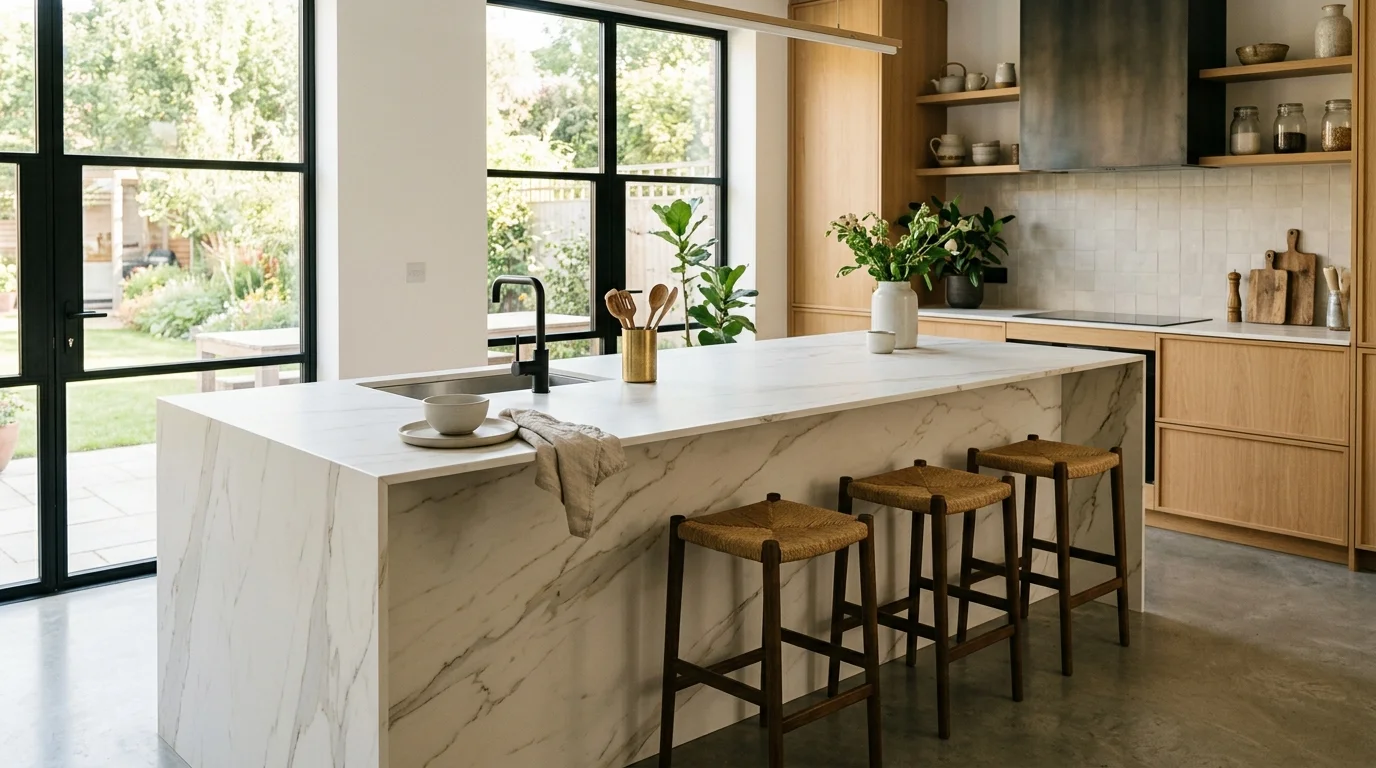
Porcelain countertops can look convincing beside quartz in a showroom. The decision gets harder once heat, sunlight, edges, seams, and fabrication enter the conversation. Compare the exact slabs and written specifications, not broad claims about either material.
Category tendencies below come from named manufacturers. They are not a promise that every porcelain slab beats every quartz slab.
How porcelain slab is made
Neolith describes sintered stone as natural minerals compacted under extreme heat and pressure into an ultra-compact slab. Its process pages list grinding and atomizing minerals, pressing without glues, then sintering around 1,200°C. Neolith publishes indoor and outdoor use, including kitchens, terraces, pools, and facades, plus low porosity, stain resistance, UV resistance, and heat resistance. Thicknesses vary by collection. Recent kitchen models are listed at 20 mm. Facade and overlay formats can be much thinner, including 6 mm and even 3 mm cladding. Thin is not automatically right for a countertop edge.
Cosentino’s Dekton line sits in the same ultra-compact family: sintered minerals, indoor/outdoor, soap-and-water care, and a thickness table that treats 4 mm Slim as cladding rather than a free-span worktop. Caesarstone, by contrast, describes its quartz as up to 90 percent quartz mineral with resin, nonporous, and generally indoor unless you buy its Outdoor or Solaris collections.
That split is the useful comparison. Porcelain and sintered slabs are ceramic-family surfaces fired or sintered without a polymer binder. Quartz is an engineered stone bound with resin. Resin is why many quartz makers warn against direct hot pans and untreated outdoor UV. Ceramic-family slabs can take thinner visual edges, but they can also chip at unsupported corners and need a fabricator who works that exact brand.
| Topic | Porcelain / sintered slab (Neolith, Dekton as published) | Quartz (Caesarstone as published) |
|---|---|---|
| Composition | Natural minerals, heat and pressure, no polymer binder in the sintered process | Up to about 90% quartz with resin and pigments |
| Heat | Makers publish high-temperature and outdoor-kitchen use | Heat resistant, not heat proof; trivets required |
| UV / outdoor | Published for exterior kitchens, terraces, and facades | Standard indoor quartz is not for prolonged UV; outdoor lines are separate |
| Stain / porosity | Low porosity, soap-and-water cleaning | Nonporous, no sealer, soap and water |
| Edges | Thin and mitered looks are common; pattern may not run through every slab | Thicker built-up edges are common; through-body look depends on the product |
| Fragility | Thin edges and cutouts can chip; handling and support are critical | Impact and thermal shock still matter, especially at edges |
| Fabrication | Brand-specific tools, supports, and adhesives | Brand-specific fabrication and indoor/outdoor rules |
We still couldn’t confirm one manufacturing description, heat limit, or chip rate that applies to every porcelain product. Ask for the current technical data sheet, installation manual, and care guide for the exact brand, collection, finish, and thickness.
Start with the manufacturer’s current technical data sheet. Request the installation manual and written care instructions too. If those documents aren’t available, don’t substitute claims from another porcelain brand. Different names, finishes, or collections shouldn’t be treated as interchangeable without written confirmation.
Ask several direct questions:
- Does the visible pattern continue through the slab’s thickness?
- How is the surface color or pattern created?
- Which finishes are available for this exact collection?
- Are the technical specifications different between finishes?
- What installation materials does the manufacturer specify?
- Are there restrictions involving sinks, cooktops, edges, or overhangs?
- Which written warranty terms apply, and who provides that warranty?
Keep product samples labeled. Record the manufacturer, collection, color, finish, and identifying product information. A loose sample without those details won’t help if the final slab differs from what you reviewed.
The manufacturer’s documents should guide the product discussion. The fabricator’s written plan should guide cutting and installation. Those are separate conversations, and both matter.
If porcelain is part of a larger kitchen countertop installation, bring the slab information into the planning stage. That lets the local pro compare the product documentation with the proposed sink, cooktop, cabinets, and edge design before work begins.
Heat, UV and scratch performance
Heat, UV, and scratch claims often drive comparisons between porcelain and quartz. We couldn’t confirm product-wide performance limits for either material. We can’t state that every porcelain countertop handles a hot pan, direct sunlight, or a sharp object better than every quartz product.
Treat each claim as a request for evidence. If a seller says a slab resists heat, ask for the documented temperature limit. Ask whether the manufacturer requires a trivet or another protective surface. Also request any exclusions involving thermal shock, heated appliances, or rapid temperature changes.
For UV performance, describe the actual room. A west-facing kitchen in La Jolla presents a different design question than an interior countertop without direct sun. Ask whether the selected color and finish are approved for that exposure. Get the answer in the manufacturer’s current documentation.
Scratch resistance needs the same discipline. Ask which test supports the claim, what the result means, and whether the finish changes that result. Also check the care guide for approved cleaners and tools. A broad label such as “scratch resistant” doesn’t explain how the manufacturer expects the surface to be used.
Bring comparable paperwork for the quartz option. Our quartz versus quartzite guide explains why names and categories need careful review. The same principle applies here. Compare exact products, not one showroom sample against a general memory of another material.
Create a short comparison sheet for both choices. Include documented heat limits, sunlight guidance, care instructions, exclusions, and warranty terms. Leave a field blank when the manufacturer hasn’t confirmed it. An honest blank is more useful than an unsupported promise.
Where porcelain gets fragile
We couldn’t confirm where every porcelain product becomes fragile. We also couldn’t confirm product-wide chip rates, impact limits, acceptable overhangs, or minimum distances around cutouts. Those questions need answers from the manufacturer and fabricator for your chosen slab and installation plan.
Focus the review on places where the counter’s shape changes. Ask the fabricator to discuss sink openings, cooktop openings, faucet holes, corners, seams, overhangs, and exposed edges. Request a marked drawing showing those locations before fabrication begins.
Don’t accept a general statement that the material is “strong.” Ask what the written product instructions allow at each location. If the fabricator recommends something different, ask for the reason and get the final choice documented.
Edge samples deserve close inspection. View them from standing and seated positions. Look at the top, underside, corner, and joint. If the visible design changes at an edge, decide whether that appearance works before approving fabrication.
The route into the kitchen matters too, but the correct handling plan depends on the slab and property. A Downtown San Diego condo, a Chula Vista house, and an El Cajon remodel can present different access conditions. Ask the installer to review doors, elevators, stairs, turns, and the final work area.
Damage procedures should be settled before installation. Ask who documents existing conditions, who decides whether a chip is repairable, and whose warranty may apply. Modern Kitchen SD doesn’t provide a product or workmanship warranty. The homeowner contracts directly with the independent local professional, so warranty terms must come from that professional or the product manufacturer.
Edges, seams and the fabricator question
Porcelain comparisons can’t stop at the flat center of a showroom slab. The installed result also depends on the approved edge, seam, cutout, and support plan. Those details should be reviewed with the fabricator before the slab is ordered or cut.
Ask to see finished edge samples made from the same product. A sample from another collection won’t confirm how your selection will look. Check the profile, pattern alignment, joint visibility, and underside from normal viewing positions.
For seams, request a scaled countertop drawing. It should identify every proposed seam and the direction of each slab section. If a large island is involved, ask whether the planned layout can be fabricated from the selected slabs. Don’t rely on a rendering as proof that a specific seam layout is possible.
Discuss these questions with the fabricator:
- Which edge treatments are approved for this slab?
- Where will seams appear in the final layout?
- How will the pattern meet at corners and edges?
- What tolerances will be written into the agreement?
- Who approves slab placement before cutting?
- How will field changes be documented?
- Which party provides each applicable warranty?
Experience should be product-specific. Ask how the fabricator learned to work with the selected material and which manufacturer instructions will guide the job. Don’t treat an unsupported job count as proof of skill.
Homeowners can verify a contractor’s license through the CSLB License Check tool. License status confirms legal standing, not workmanship quality. Review the CSLB’s hiring guidance and read the written agreement before hiring.
Coordinate countertops with cabinets, appliances, plumbing fixtures, and electrical plans. For a full kitchen remodel, the matched local pro can help organize those decisions across the project.
Who porcelain is right for
Porcelain may fit your kitchen when the exact product documentation supports your priorities. It may be the wrong choice when important answers remain vague, the desired edge can’t be confirmed, or the seam plan conflicts with your design.
Start by ranking what matters most. Your list might include direct-sun placement, contact with hot cookware, a particular finish, a thin visual profile, pattern continuity, cleaning instructions, or written warranty coverage. These are evaluation criteria, not verified promises about porcelain.
Next, compare finalists using the same questions. Don’t ask detailed questions about porcelain while accepting broad claims about quartz. Request current technical data, care instructions, installation requirements, samples, seam drawings, edge examples, and warranty terms for both.
A practical selection process should include:
- Identify the exact porcelain and quartz products.
- Collect current manufacturer documents for each option.
- Mark every claim that matters to your kitchen.
- Ask the fabricator to review the proposed layout.
- Inspect product-specific edge and finish samples.
- Approve the seam plan before fabrication.
- Put product names and responsibilities in writing.
- Keep copies of care and warranty documents.
San Diego County kitchens don’t share one layout or exposure. A compact City Heights kitchen can call for different planning than a large island in Encinitas. Base the choice on the room, selected slab, and written installation plan.
Permit requirements may also change with project scope. Specific kitchen permit triggers couldn’t be confirmed. Contact City of San Diego Development Services for a City of San Diego property. For another municipality, confirm requirements with the authority serving that address.
When to call us
Call when porcelain selection affects cabinetry, sinks, appliances, seams, or a wider remodel plan. Modern Kitchen SD can match you with a licensed, independent local professional serving San Diego County.
Call us at (858) 400-4623 and we’ll connect you with a licensed local kitchen remodeler.