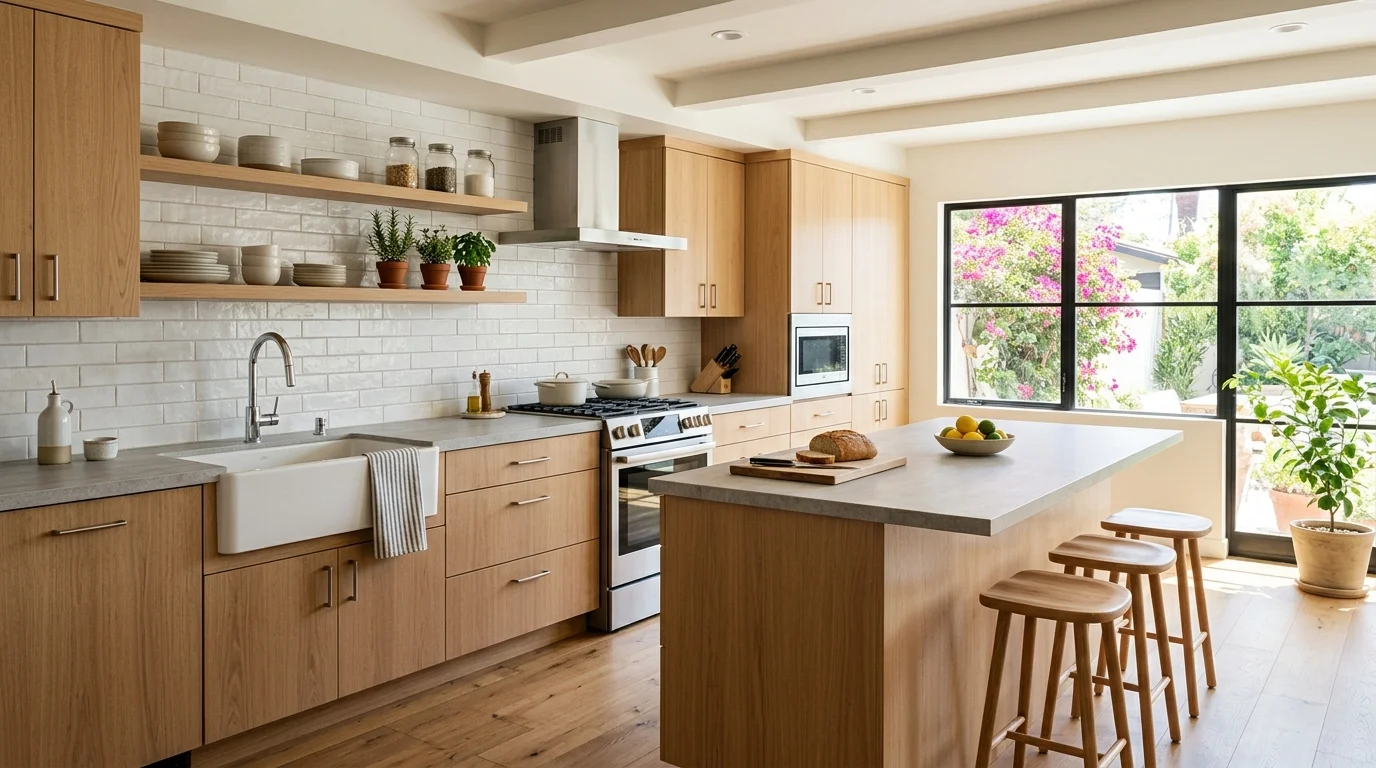
Laminate countertops can still make sense in a San Diego kitchen. The right choice depends on the exact product, room, installation plan, and daily use. No universal price or lifespan could be confirmed, so compare manufacturer specifications and written quotes from local pros.
What laminate actually is in 2026
Treat laminate as a complete countertop system, not a color sample. Wilsonart describes high-pressure laminate as kraft-paper core sheets infused with phenolic resin, a decorative paper treated with melamine, then pressed at about 300°F and more than 1,000 psi and bonded to a substrate. That construction is for interior use. It is not a stone slab, and it is not interchangeable with every printed “laminate look” product.
Formica’s published laminate care guidance is equally specific about heat and water. Cookware hot from the stove, oven, or microwave should sit on a trivet. Formica states that prolonged exposure to 140°F (60°C) or higher may separate the laminate from the core, and that the surface can withstand 275°F (135°C) for short periods. Ordinary cleaning is a damp, non-abrasive cloth and mild detergent. Do not flood the surface, especially near seams, because water can penetrate and swell the substrate. Formica’s sink guidance is for a drop-in (top-mount) sink set in waterproof caulk, with the cutout sealed. Undermount details have to come from the current product and fabricator, not from a general laminate label.
Wilsonart’s care page adds that laminate wipes with soap and water and that bleach may cause discoloration. Repair is usually a section replacement or a filler, not a polish-out. Edges and seams are where water and heat show first.
| Decision | Laminate tends to fit when | Pause or compare another surface when |
|---|---|---|
| Budget | You want a finished look at a lower material cost than stone or quartz, with a same-scope written quote | A seller fills the gap with an unsourced lifespan or price average |
| Seams and edges | You accept visible seams and a defined edge profile on the drawing | You need a long, uninterrupted island edge the fabricator cannot document |
| Sink and cooktop | Drop-in sink and cooktop details match the manufacturer’s current instructions | The plan depends on an undocumented undermount or an unsupported cutout |
| Heat and water | The household will use trivets and keep standing water off seams | Hot pans and wet edges are daily habits no one will change |
| Care and repair | Soap-and-water cleaning is enough, and a damaged section can be replaced | You expect a polish-out repair like natural stone |
| Visual options | Printed patterns, including stone looks, match the room in daylight | You need through-body veining at a mitered edge |
| Warranty | Manufacturer and installer terms are in the folder | The only promise is verbal |
Confirm the selected product’s details with its manufacturer or a licensed contractor. Construction, finish, heat limit, moisture limit, and warranty still have to match the sheet for the exact product.
Before comparing colors, identify the exact product and planned assembly. Ask the kitchen remodeler or fabricator to provide:
- The manufacturer and full product name
- The current technical sheet
- The specified surface finish and edge treatment
- Written sink, cooktop, and backsplash instructions
- Cleaning and maintenance guidance
- Product and installation warranty terms
- The party responsible for each warranty
Keep those documents with the written proposal. A showroom label alone doesn’t tell you how the finished counter will be fabricated. It also doesn’t explain where seams, edges, and cutouts will land.
Ask to see a physical sample under your kitchen lighting. City Heights morning light can read differently from strong afternoon light in an Oceanside room. Bring cabinet, flooring, and backsplash samples when possible. Judge them together, not from separate screens.
A detailed drawing matters as much as the finish. It should show the full counter layout, appliances, sink, corners, edges, and planned seams. Our kitchen countertop installation referrals can connect you with licensed, independent local pros who can review that scope. Modern Kitchen SD makes the match and performs no installation work.
Where laminate holds up and where it fails
There isn’t one publishable performance limit for every laminate countertop. Product instructions should control the decision. Ask for those limits in writing before approving the material.
Start with the busiest areas of your kitchen. For a cooking run, request the manufacturer’s heat guidance and care instructions. If people regularly set cookware directly on the counter, discuss that habit honestly. Don’t rely on a broad verbal description such as “heat resistant.”
At the sink, ask how the selected product handles cutouts, edges, fixtures, and routine water exposure. Request a drawing of the sink detail. The proposal should also identify who handles any required follow-up if that area changes after installation.
Check other demanding locations separately:
- The counter beside a range or cooktop
- The area above a dishwasher
- A coffee or beverage station
- An appliance garage
- An island used for meals, homework, or food preparation
- Corners where small appliances may be moved often
A compact North Park galley and a Chula Vista family kitchen can place different demands on the same finish. Base the choice on the actual room and household, not the neighborhood name.
Ask how to clean the surface and which products aren’t approved. Get the answer from the current manufacturer document. If a salesperson can’t produce that document, pause the decision.
Some remodel scopes can involve permits or energy requirements. Specific kitchen permit triggers couldn’t be confirmed. Building permits may be required depending on the scope. For a property within the city, check with City of San Diego Development Services. Don’t assume a countertop-only proposal answers questions about connected plumbing, ventilation, lighting, or structural work.
Laminate versus quartz on cost and lifespan
A verified current San Diego price range for laminate or quartz couldn’t be confirmed. Neither could a verified lifespan figure for either material. Any generic dollar amount or promised number of years would be unsupported, so we won’t provide one.
Use comparable written proposals instead. Each proposal should cover the same dimensions and scope, including:
- The exact product and finish
- Fabrication and installation
- Edge treatments and seam locations
- Sink and cooktop cutouts
- Backsplash or wall transitions
- Removal and disposal, when included
- Cabinet or substrate preparation
- Taxes and other stated charges
- Exclusions and possible change-order items
A proposal that omits preparation or removal isn’t directly comparable with one that includes both. Ask the pro to mark every excluded item. This is especially useful when an older kitchen has counters, cabinets, or walls that won’t remain as they are.
For lifespan, replace broad promises with product-specific questions. Ask what the manufacturer covers, how long that written coverage lasts, and which conditions are excluded. Ask the installer what workmanship coverage they provide. Modern Kitchen SD doesn’t issue warranties because it doesn’t sell or install the countertop.
Repair expectations also belong in the comparison. Ask what happens if an edge, seam, or cutout needs attention later. Can the affected section be addressed independently, or would a larger portion need replacement? The answer may depend on the selected product and layout.
If quartz remains on your list, read our quartz versus granite countertop comparison for another way to organize material questions. Then place each written proposal beside your laminate option and compare identical scope.
Edge and seam limits you should know
Edges and seams can change how a countertop looks from across the room. They also affect where your eye stops along a long run. Review them before approving the final order.
There isn’t a verified universal seam spacing, overhang, or edge limit. The selected manufacturer and fabricator should supply those details. Ask for a scaled drawing that identifies every seam and finished edge.
Look closely at these locations:
- Inside and outside corners
- The front edge beside a sink
- Ends next to a refrigerator or tall cabinet
- The joint between the counter and backsplash
- Cooktop and sink cutouts
- Peninsula and island ends
- Any exposed side visible from another room
For a long Escondido counter or an Otay Ranch island, ask the fabricator to explain why each seam sits where it does. If a seam-free appearance is essential, state that before selecting the product. Don’t wait until fabrication begins.
Request a physical edge sample when one is available. A small surface chip doesn’t show the completed profile, corner, or transition. View the sample from standing and seated positions. This matters at breakfast bars and open kitchen islands.
Get appearance expectations in writing. Avoid vague promises about an “invisible” seam or “perfect” match. Instead, ask what the completed joint should look like and what variation the product documents allow.
The drawing should also identify walls that aren’t straight and corners that aren’t square, if the pro finds them during measurement. Ask how those conditions would affect the proposed edge, seam, backsplash, or installation scope. Approval should happen after those details are visible.
Kitchens where we’d steer you elsewhere
We’d pause a laminate selection when the project documents don’t answer the room’s main risks. A color you like isn’t enough if the exact product, edge, seam, care instructions, or warranty provider remains unclear.
Consider another surface when a required design can’t be supported in writing. That may include a long uninterrupted appearance, a particular edge profile, an unusual cutout, or a specific sink arrangement. Ask the pro to show which documented requirement creates the conflict.
Daily habits matter too. If your household won’t follow the manufacturer’s care guidance, choose with that reality in mind. A countertop shouldn’t depend on routines nobody plans to keep. The same applies when several people cook, children use the island, or tenants control day-to-day care.
We’d also slow down when the counter is only one part of a changing layout. Moving cabinets, replacing a sink, altering an island, or revising nearby walls can affect the proper scope. For a compact condo or galley, a small kitchen remodel referral can help you connect with a licensed pro who can examine the whole plan.
Permit requirements couldn’t be confirmed for every kitchen scope. Ask the authority responsible for the property before work begins. For contractor verification, California homeowners can use the CSLB License Check tool. It supports searches by license number, business name, personnel name, and Home Improvement Salesperson information. License status confirms legal standing, not the quality of a proposed countertop plan.
Finally, step away from any proposal built on unsupported price, lifespan, or performance promises. Request the product sheet, detailed drawing, itemized scope, and written terms. If those documents still don’t resolve the concern, compare another product.
When to call us
Call when countertop selection affects cabinets, sinks, cooktops, seams, or a larger kitchen remodel. Call us at (858) 400-4623 and we’ll connect you with a licensed local kitchen remodeler.