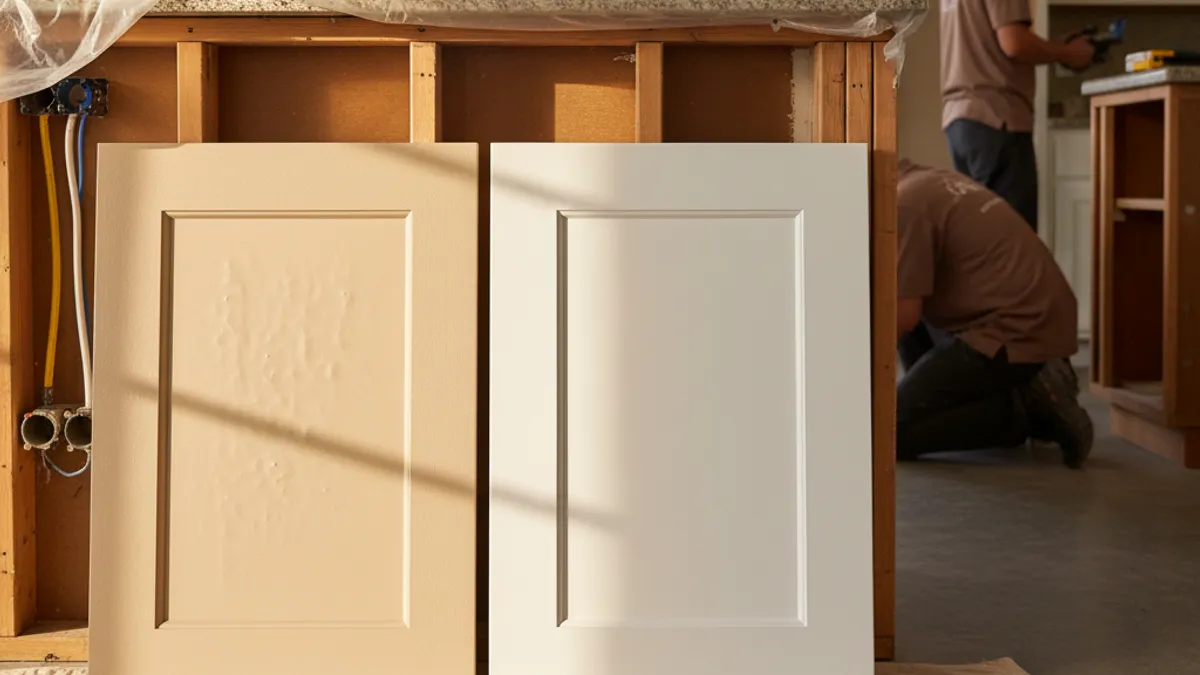
Kitchen cabinet refinishing means stripping, sanding, and applying new paint or stain to your existing cabinet doors and boxes without adding any new materials. It’s the most affordable way to update a kitchen. This method works well for solid wood cabinets in good structural condition. If your cabinet boxes are damaged or made of peeling laminate, refinishing won’t fix them.
What kitchen cabinet refinishing actually involves
Kitchen cabinet refinishing is a labor-intensive process that relies on heavy preparation. A cabinet refinisher works through a strict sequence to make the new finish stick. First they remove all doors, drawers, and hardware, then take those pieces to an off-site shop or a heavily ventilated area in your home.
Before any sanding happens, the crew spends hours cleaning. Kitchens trap microscopic layers of bacon grease, olive oil, and dish soap on the cabinet faces over the years. If a painter sands before cleaning, they just push that grease deeper into the wood grain. The primer will eventually fail, and the paint will flake off in sheets. Proper degreasing with chemical agents like trisodium phosphate is the most vital step of the whole job.
After degreasing, they sand the existing finish. They don’t always strip the wood down to bare timber. They just need to remove the glossy clear coat so the primer can grip the surface. They fill any deep scratches or old hardware holes with wood putty.
Then they apply a bonding primer. This layer blocks old wood tannins from bleeding through the new color. Finally, they apply two coats of high-quality cabinet enamel. Most professionals spray the doors for a perfectly smooth finish and roll or brush the cabinet boxes left in your kitchen.
Why older San Diego homes are great candidates
San Diego has thousands of homes built between the 1950s and the 1970s. Neighborhoods like Clairemont, Allied Gardens, and Bay Park feature classic ranch-style architecture. The kitchens in these homes often still have their original solid wood cabinetry.
Solid wood is the perfect candidate for kitchen cabinet refinishing. The wood grain is strong, and the boxes are usually built to last. If you live in one of these older neighborhoods, you likely have a great foundation. You can keep the original footprint of your kitchen and just update the color.
Homes with particle board or medium-density fiberboard cabinets are different. If water has swollen the base cabinets near your sink, paint won’t hide the damage. You need solid, uncompromised surfaces for a refinish to look good.
How coastal and inland climates affect your cabinets
Your local climate plays a massive role in how your kitchen cabinets age. San Diego County has distinct microclimates that affect building materials differently.
Coastal areas face constant salt air and marine layer moisture. Kitchens in La Jolla, Coronado, Pacific Beach, Del Mar, and Ocean Beach deal with high ambient humidity. This moisture is notoriously hard on thermofoil cabinets. Thermofoil is a plastic coating baked over a pressed wood core. Over time, the coastal air causes the plastic to peel away from the wood.
Refinishing doesn’t fix peeling thermofoil. Paint can’t glue the plastic back down, and it won’t stick to the exposed glue layer underneath. If you have peeling coastal cabinets, you need to look at other options.
Inland and rural areas face the opposite problem. Homes in Hidden Meadows, Jamul, Harbison Canyon, and Borrego Springs experience intense dry heat. Wood cabinets in these areas can shrink, crack, or warp over decades of temperature swings. However, if the wood in your inland home is still structurally sound, it will take stain or paint beautifully. The dry air actually helps cabinet enamels cure faster and harder.
The materials professionals use for lasting results
Homeowners often wonder why they shouldn’t just buy a can of interior trim paint from the hardware store. Standard acrylic paints remain soft and flexible even after they dry. When you close a painted cabinet door against a painted frame, the two surfaces can fuse together. This is called blocking. When you pull the door open, the paint rips right off the wood.
A refinisher uses coatings designed strictly for cabinetry. They often apply catalyzed lacquers or waterborne alkyd enamels. These products undergo a chemical reaction as they dry. They cure into a hard, plastic-like shell that resists chipping, scratching, and blocking.
These industrial coatings require heavy ventilation and professional spray equipment. Workers must mask off your entire kitchen with plastic sheeting to protect your appliances and countertops from overspray. This level of protection and the cost of premium materials are exactly why hiring a professional yields better results than a weekend do-it-yourself attempt.
Refinishing compared to refacing
Homeowners often confuse refinishing with refacing. They’re completely different projects with different costs and timelines.
Refinishing keeps everything you currently own. You keep the same doors, the same drawer fronts, and the same boxes. You just change the color.
Kitchen cabinet refacing replaces the doors and drawer fronts entirely. You keep your existing cabinet boxes, but workers apply a new wood or laminate veneer over them to match the brand new doors. You can read our complete kitchen cabinet refacing guide to see exactly how that process works.
If you want to change the style of your doors from flat panels to Shaker style, you must reface. Refinishing can’t change the physical shape of your doors. If your doors are structurally ruined, you must reface or replace. You can explore our kitchen cabinet refacing service page to learn more about upgrading your door styles.
Decision framework for your kitchen
Use this simple framework to decide which path makes sense for your home.
Choose kitchen cabinet refinishing when:
- You love the current physical shape of your doors.
- Your cabinets are made of solid wood or intact, high-quality MDF.
- Your cabinet boxes have no water damage or swelling.
- You want the most affordable update possible.
Choose kitchen cabinet refacing when:
- You want a totally different door style.
- Your current doors are peeling thermofoil or chipped laminate.
- Your cabinet boxes are still perfectly square and strong.
- You want a factory-new look without the cost of a full demolition.
Choose full cabinet replacement when:
- You want to change the physical layout of your kitchen.
- Your cabinet boxes are rotting, sagging, or water-damaged.
- You’re tearing down walls to open up the floor plan.
Understanding project costs and timelines
Cost is usually the biggest factor for homeowners. Refinishing is the cheapest of the three main options because it requires zero new materials. You’re only paying for labor, prep supplies, and paint.
We can’t confirm a standard county-wide price for kitchen cabinet refinishing. Every project varies based on the size of the room and the condition of the wood. You must confirm the current rate with the professional you hire before you pay. You can review our kitchen remodel cost San Diego guide to understand how different trades price their time.
A typical refinishing job takes about one to two weeks. Day one goes to removing doors and masking off the kitchen. Several days go to prepping and painting the frames in place while the doors cure back at the shop. You lose access to the kitchen for at least a few days while the frames dry.
What Modern Kitchen SD does and does not handle
Straight answer, because it decides whether this page is any use to you. The crews we match homeowners with across San Diego County handle cabinet refacing and full cabinet replacement. They do not do stain-only refinishing. If you have read this far and concluded that a repaint is all your kitchen needs, a cabinet painter or a finish carpenter is the right call, and you do not need us for it.
Where we are worth a phone call is the decision itself. Most homeowners who search for refinishing are really asking a different question: is paint enough, or has the cabinetry passed the point where paint fixes it? Peeling thermofoil, a swollen sink base, a layout that never worked, doors you have stopped liking. Those are refacing and replacement questions, and getting them wrong costs a lot more than the paint would have.
Start with the kitchen cabinet refacing service page, or look at the San Diego kitchen remodel page and the wider county service area to see how the matching works. Call (858) 400-4623 and describe what the cabinets are doing. If refinishing is genuinely your answer, we will tell you that too.
Frequently asked questions
Can you refinish cabinets without sanding them?
No, you must sand cabinets before refinishing them. Sanding removes the old glossy clear coat and gives the new primer a textured surface to grip. If you skip sanding, the new paint will scratch off easily.
How long does cabinet paint take to cure?
Cabinet paint takes up to thirty days to fully cure and harden. While the paint feels dry to the touch within a few hours, the chemical hardening process takes weeks. You should treat your newly painted cabinets very gently during this first month.
Will refinishing hide the wood grain?
Solid paint will hide the color of the wood grain, but it often won’t hide the physical texture. Heavy-grained woods like oak will still show a bumpy texture through the paint unless the contractor uses a grain filler first. If you want a perfectly smooth surface, ask your pro about grain filling.
Can I change from a dark stain to a light paint?
Yes, you can transition from a dark wood stain to a light paint color. The contractor will use a high-quality, stain-blocking primer to prevent the dark tannins from bleeding through. It usually takes one coat of primer and two coats of light paint to achieve full coverage.
Is it cheaper to paint cabinets or replace them?
Painting your existing cabinets is significantly cheaper than replacing them. Replacement requires buying entirely new wooden boxes, paying for demolition, and often paying for new countertops and plumbing fixes. Refinishing only costs you the price of labor and paint.
Do I need to empty my cabinets before they are painted?
Yes, you need to completely empty your cabinets and drawers before the project begins. Workers need clear access to the inside edges of the cabinet frames to tape them off and paint them. Emptying the cabinets also protects your dishes from dust and paint fumes.