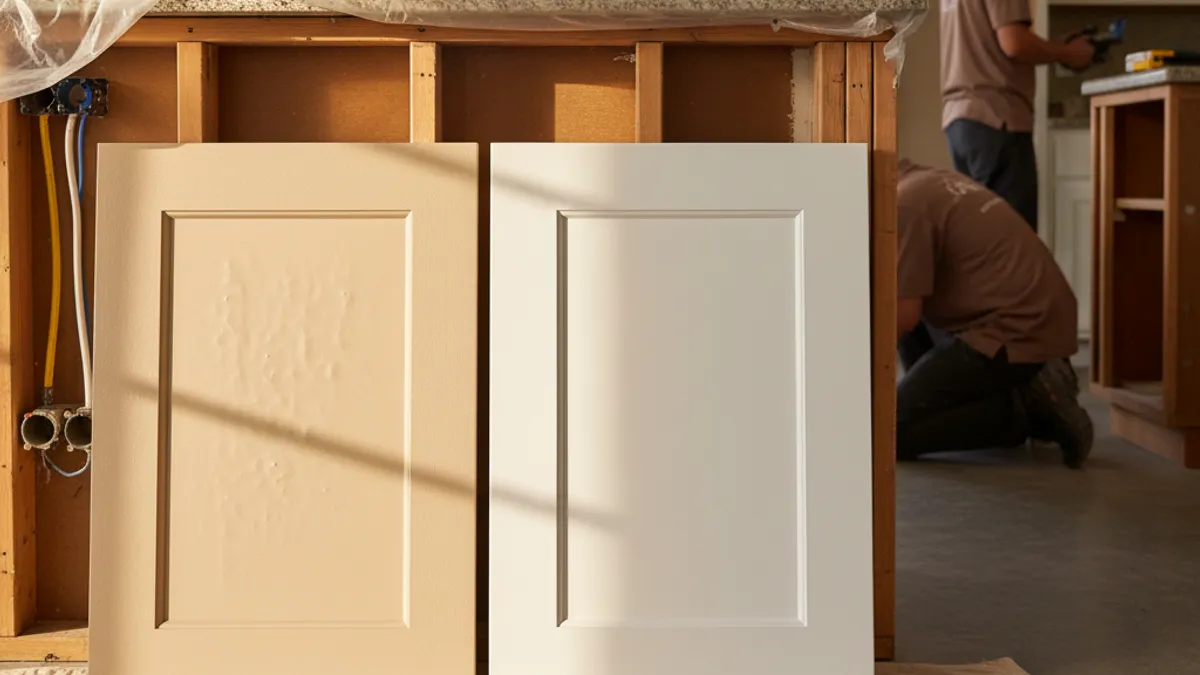
Cabinet refacing is a new exterior on boxes you keep. New doors, new drawer fronts, and a new skin on the visible cabinet faces can change the kitchen’s look without a full tear-out. It is the right project when the boxes are sound and the layout already works. It is the wrong project when the boxes are swollen, out of square, or in the wrong place.
This page does not publish a San Diego refacing price, a savings percentage, or a guaranteed day count. Those numbers are not in the approved research. The useful work is knowing what refacing includes, what it does not, and how to qualify the boxes before anyone orders doors.
What refacing is, and what it is not
Refacing keeps the cabinet boxes and the kitchen layout. The visible work is new doors, new drawer fronts, and new material on face frames, exposed ends, and often the toe kick. Hinges usually change with the doors because the new doors need hardware that fits them.
Refacing is not stain-only refinishing. Stain-only work coats the doors and boxes you already have. If you want that path, read the stain-only finish guide. The independent remodelers we match handle refacing and full replacement, not stain-only door work.
Refacing is not a drawer-glide upgrade. New doors and new drawer fronts can go on the existing drawer boxes. New full-extension glides are a separate hardware decision. They can be worth doing while the kitchen is apart, but they are not “included in refacing” unless the proposal names the runner, the load rating, and the drawer-side thickness. Follow the runner maker’s current spec. A new front on an old, worn glide is a different job than a new front on a new runner.
Refacing also does not add an island, move a sink, or create a pantry wall. Those are replacement or remodel scopes. See kitchen cabinet refacing for the matching path, and full kitchen remodel when the layout is the problem.
When the boxes qualify
Refacing only pays off if the boxes can take new doors and a new skin. Walk the kitchen with the remodeler and write down what you see.
A kitchen is a candidate when:
- Boxes are square, plumb, and firmly attached to the wall and to each other
- No soft, swollen, or delaminated substrate at the sink, dishwasher, or fridge line
- Face frames, if you have them, can take new hinges and a new skin
- The layout works for how you cook
- You want a style or color change, not a new floor plan
- The countertop plan is clear: keep it, or replace it on a schedule that fits the new doors
Tract kitchens in Mira Mesa, Scripps Ranch, Rancho Bernardo, and older parts of Chula Vista often have boxes that are still usable. That is an observation about common layouts, not a claim that homes built after a certain year automatically qualify. Particleboard, plywood, and MDF all fail when they stay wet. Age is not the test. Condition is.
Ask the remodeler to open sink bases, the dishwasher end, and any cabinet that has seen a leak. A good reface quote includes that inspection. If a box has to be rebuilt or replaced, that line should appear before doors are ordered.
When replacement is the better path
Do not reface a failing cabinet. Peeling thermofoil on an MDF door is a door problem. Peeling thermofoil plus a swollen, crumbling box is a replacement problem. A new door on a soft sink base will not stay aligned.
Replace instead of reface when:
- Boxes are out of square, racked, or pulling off the wall
- Substrate is swollen, delaminated, or mold-damaged
- You need a new island, a moved sink, or a different pantry
- Interior storage is the real complaint, and the box sizes cannot take the inserts you want
- Enough individual boxes fail that a mixed reface-and-replace kitchen will look patched
A remodeler who tells you to replace, and explains why in writing, is doing the honest job. A remodeler who will reface anything is selling doors.
Doors, skins, RTF, and hardware as separate lines
The look of a refaced kitchen is the door and the skin. Those are different products.
Doors and drawer fronts. Shaker, slab, and inset are style names, not a spec. Ask for the door material, core, profile, finish name, overlay, and edge. Inset only works on a face-frame box that can be fitted that tightly. Do not pick the door on install day. Doors are a lead-time item, and the current timing comes from the manufacturer on your order, not from a blog.
Box skins. Veneer, laminate, paint-grade material, and rigid thermofoil are not interchangeable. Ask which surfaces get the new skin: face frames, exposed ends, island backs, and the toe kick. An end panel and a narrow frame are different pieces.
Rigid thermofoil (RTF). RTF is a film over a formed core. It is one option, not “the most moisture-resistant finish.” Heat near a range, steam at a dishwasher, and the maker’s care sheet decide whether that film is in-scope. If a seller claims RTF is automatically better at the sink than paint or wood, ask for the product literature. If they cannot produce it, treat the claim as marketing.
Hardware. Hinges should be specified by overlay, cup, and door weight. Pulls and knobs are their own line. Drawer runners, if upgraded, are their own line. Do not let “new hardware” hide a reuse of worn glides.
A new countertop and a new kitchen backsplash often pair with refacing because the doors are off and the walls are easier to reach. Those are add-on scopes. They should appear as add-on scopes.
Sequence, quotes, and what to ask
A refacing project has a real order: measure and inspect, order doors and skins, protect the kitchen, remove old doors and hardware, repair boxes, apply skins, hang doors, set hardware, adjust reveals, punchlist. How many days that takes depends on door count, finish, and whether the work stays on site or uses a shop. We could not confirm a standard San Diego on-site duration, so this page will not publish one.
Ask for a count sheet before you compare totals. It should list doors, drawer fronts, false fronts, end panels, toe kicks, and specialty pieces. Two kitchens of similar size can have very different counts.
Then ask:
- Which boxes stay, and which, if any, will be replaced
- How the substrate will be cleaned and prepared before a new skin
- Whether hinges are new, and what they are rated for
- Whether drawer boxes keep their existing glides
- What happens if a hidden leak is found after doors are ordered
- Whether the kitchen can be used during the work, and which days it cannot
No verified San Diego refacing price band appears in the approved research. Compare matching count sheets and matching materials. A lower number that skips end panels or reuses old glides is not a better reface.
Building permits may be required depending on the rest of the project. Cabinet refacing by itself is not a reason to invent a City of San Diego trigger. Confirm wider plumbing, electrical, or structural work with Development Services at 619-446-5000, or with the authority for your address.
Before hiring, verify the contractor through the CSLB License Check. For covered California home improvement contracts, Business and Professions Code §7159 limits the down payment to $1,000 or 10 percent of the contract price, whichever is less.
When to call us
Call when the boxes look usable, the layout works, and you want a licensed remodeler to inspect them and price refacing against replacement. Modern Kitchen SD matches San Diego County homeowners with licensed, independent local professionals. Call us at (858) 400-4623 and we’ll connect you with a licensed local kitchen remodeler.